Amazing Mont St. Michel

Well here we are in Mont St. Michel.  I feel like I’ve known about this place forever – afterall, I did have the jigsaw puzzle as a child!  Before we get started, here’s a little history that I hope you’ll find interesting.

Le Mont Saint Michel is an island community in Normandy, located about .6 miles off France’s northwestern coast, at the mouth of the Couesnon River. At 247 acres in size, the island today has a population of 44, compared to a high of just over 1,000 in the mid 1800’s. One of France’s most recognizable landmarks, Mont Saint-Michel and its bay are part of the UNESCO list of World Heritage Sites and more than 3 million people visit each year.

The island has held strategic fortifications since ancient times and since the 8th century AD has been the seat of the monastery from which it draws its name. The structural composition of the town exemplifies the feudal society that constructed it: on top, God, the abbey and monastery; below, the great halls; then stores and housing; and at the bottom, outside the walls, houses for fishermen and farmers.

Historically, its unique position on an island made it accessible at low tide to the many pilgrims to its abbey, but defensible as an incoming tide stranded, drove off, or drowned would-be assailants. Eventually, awareness of the reverse benefits of its natural defense resulted in turning the Mont into a prison. Thereafter the abbey began to be used more regularly as a jail.

The tides can vary greatly, at roughly 46 ft between high and low water marks. Popularly nicknamed “St. Michael in peril of the sea” by medieval pilgrims making their way across the flats, the mount can still pose dangers for visitors who avoid the causeway and attempt the hazardous walk across the sands from the neighboring coast.

Polderization and occasional flooding have created salt marsh meadows that were found to be ideally suited to grazing sheep. The well-flavored meat that results from the diet of the sheep in the salt meadow makes salt meadow lamb a local specialty that may be found on local restaurant menus.

The connection between Mont Saint-Michel and the mainland has changed over the centuries. Previously connected by a tidal causeway, a path uncovered only at low tide, this was converted into a raised, permanently dry, causeway in 1879. In 2006, authorities announced a €164 million project to build a hydraulic dam to make Mont Saint-Michel an island again. The dam project which began in 2009 also included the removal of the causeway and its visitor car park. The new car park on the mainland is located 1.6 miles from the island and visitors can walk or use shuttles to cross the causeway.

In 2014 a new bridge was opened to the public, allowing the waters to flow freely around the island and improve the efficiency of the dam. The new bridge was completely submerged on March 21, 2015, by an extremely high ‘supertide,’ the highest sea level for at least 18 years.

Le Mont-Saint-Michel has long “belonged” to some families who shared the businesses in the town, and succeeded to the village administration. Tourism is the main and even almost unique source of income of the community. There are about 50 shops for 3 million tourists, while only 25 people sleep every night on the Mount (monks included), plus guests in the island’s 6 small hotels.

We’re here!

Getting to the island is a bit challenging.  You must find and park in the appropriate parking lot, which in and of itself is a challenge.  Then you catch one of the few horse-drawn wagons or one of several buses that go to the “island.”  Buses IMG_1424[1]are easier to find but they drop you off 1/4 mile from the entrance and you have to walk the last distance – with baggage in tow.  We’re spending 2 nights in one of the little hotels right on the island and fortunately our hotel is just inside the drawbridge so we don’t have far to walk once we reach that point.  But, and stop me if you’ve heard this before, our room is on the 4th floor and there’s no elevator!  It’s deja vous (the only French words I know!) all over again, as Yogi Berra would say.  By the time we get here late in the afternoon, people are beginning to leave the island in droves.  The tide is coming in and the water is rising and we’re anxious to see if it really will become an island. (Because of the silt, it doesn’t any more.)

Early in the morning, it’s very quiet and the pedestrian streets (duh – they’re all pedestrian streets) are deserted. But once all those busloads of 5th and 6th graders arrive, it’s wall to wall people again. We went up to the Abbey and took a self-guided tour with the audio guides. It was fascinating and beautiful. The lighting is so well done in the Abbey – it makes it even more impressive.

Most of these photos have no captions – I just wanted to show a little bit of what’s here.

The drawbridge at the entry.


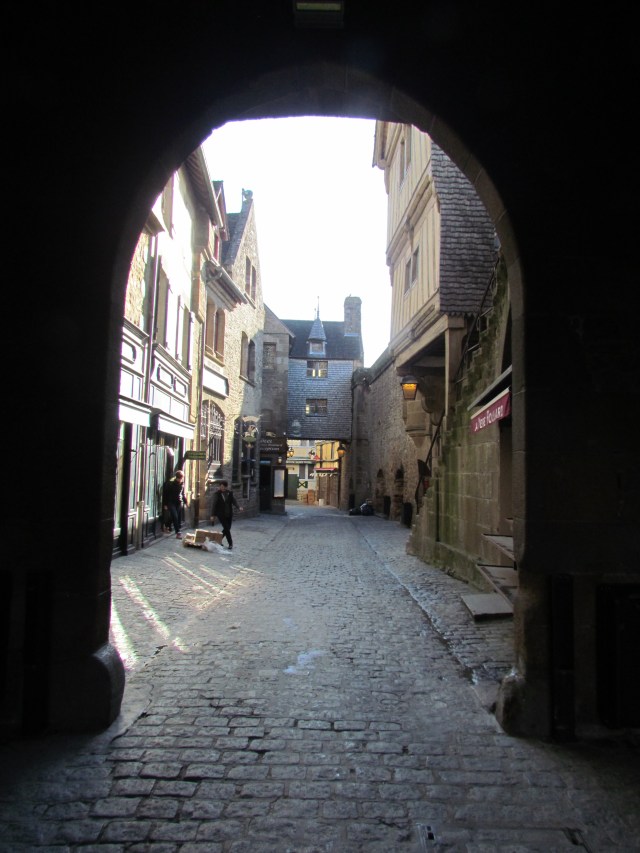
The street that our hotel is on.
The street that our hotel is on – before the crowds got here.


Chuck waving to the seagulls from our hotel room.


Windows in a church outside of the abbey.
Windows in a little church just outside of the abbey.


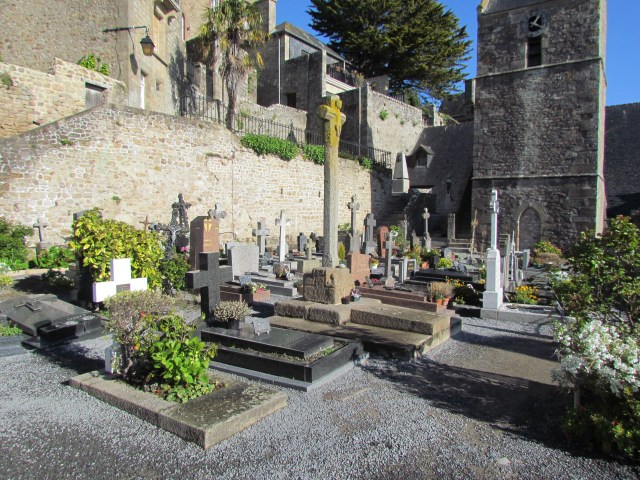
A cemetery outside of that same church.


The Abbey

At the top of Mont St. Michel is The Abbey. Benedictine monks started building this abbey on the mount in the 10th century. The heroic resistance of the Mount to English attacks during the Hundred Years’ War in the 14th and 15th centuries made it a symbol of French national identity. Monks left the abbey in 1790, and it was listed as a historic monument in 1874.

IMG_1273[1]

IMG_1275[1]


IMG_1286[1]

IMG_1288[1]

IMG_1292[1]

IMG_1372[1]

IMG_1374[1]

IMG_1382[1]

IMG_1384[1]

IMG_1297[1]

IMG_1304[1]

IMG_1312[2]

IMG_1320[1]

IMG_1330[1]

IMG_1332[1]

IMG_1343[1]

IMG_1352[1]

IMG_1358[1]

IMG_1361[1]

IMG_1392[1]

IMG_1395[1]

IMG_1396[1]

IMG_1405[1]

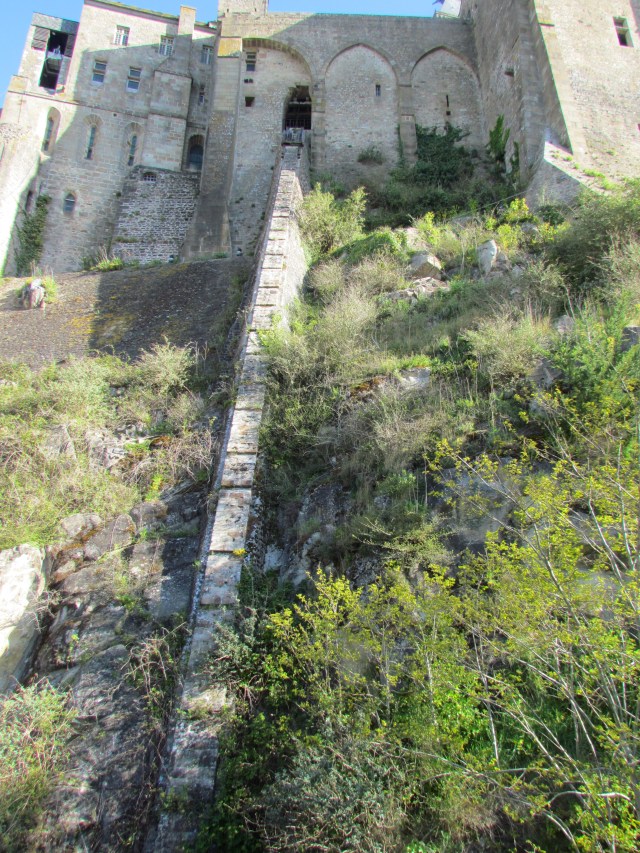
This was an elevator for transporting supplies into the abbey.
This was an elevator used for transporting supplies into the abbey.


Men walking in this wheel were the power which pulled the rope to bring up supplies on the sled-pallet shown to the right of the wheel.


Traveling to Mont St. Michel

After breakfast at our B&B this morning, we fired up our little red Fiat and made the 150-mile journey from Amboise to Mont St. Michel. We were in no hurry and it was beautiful driving through the lush green countryside. Once we got over to the coast, we drove through Dinard, an upscale community with huge old stone homes on hilly streets along the coast.  So 2 toll roads, a stop for gas, and a couple of rest stops later, we approached Mont St. Michel with our first gasp of amazement as it came into view.  (Actually that was me – Chuck has been here before.)  Tomorrow we begin our adventure in Mont St. Michel so today I’m just going to share a few photos from the drive.

There are very few signs along the freeway, especially no billboards, but they did have these attractive signs showing where the major chateaux and tourist attractions are.
There are almost no signs along the freeway, most notably we’ve seen no billboards, but they did have these attractive signs showing where to exit for the major chateaux and tourist attractions.


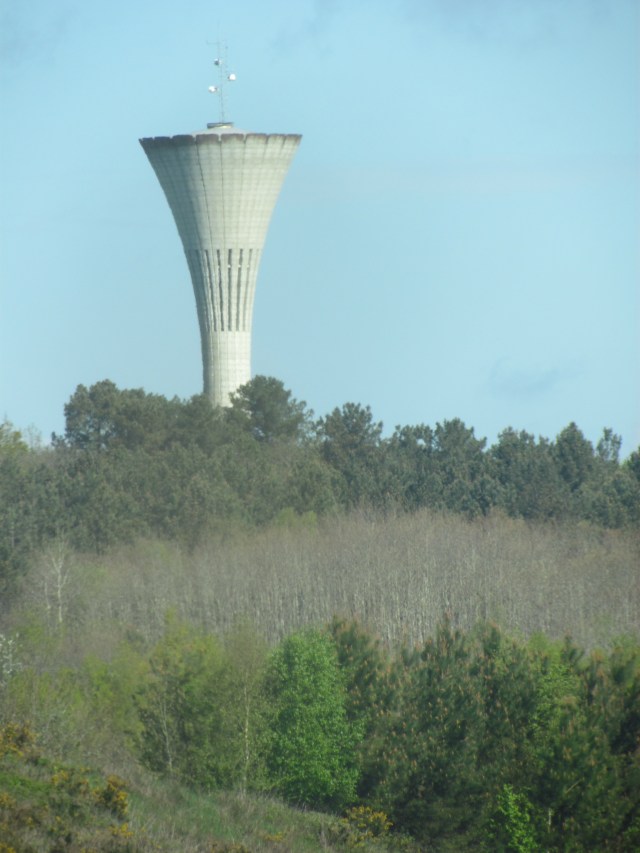
All of the water towers appear to be poured out of this same mold. The only difference in them is their size - the ones in the country are very small.
All of the water towers appear to be poured out of this same mold. The only difference in them is their size – the ones in the country are very small.


There were lots of cows along the roadside of all different varieties. The fields are all filled with beautiful green grass so the contrast is very appealing.
There were lots of different varieties and colors of cows in the pastures along the roadside. The fields are all filled with beautiful green grass so the contrast is very appealing.


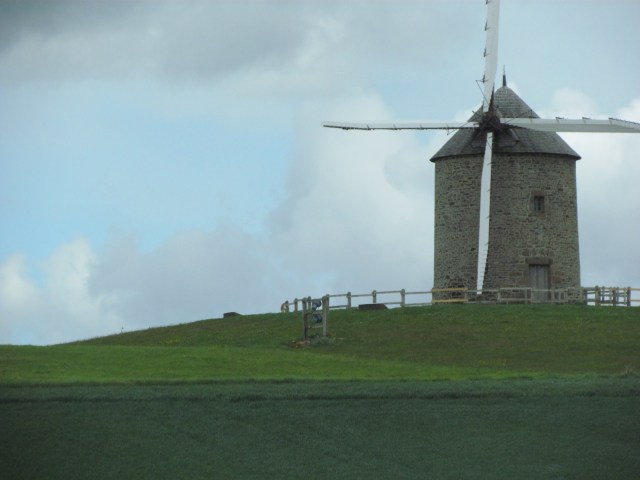
This is the only windmill we've seen so far (and I almost missed it!).
This is the only windmill we’ve seen so far (and I almost missed it!).


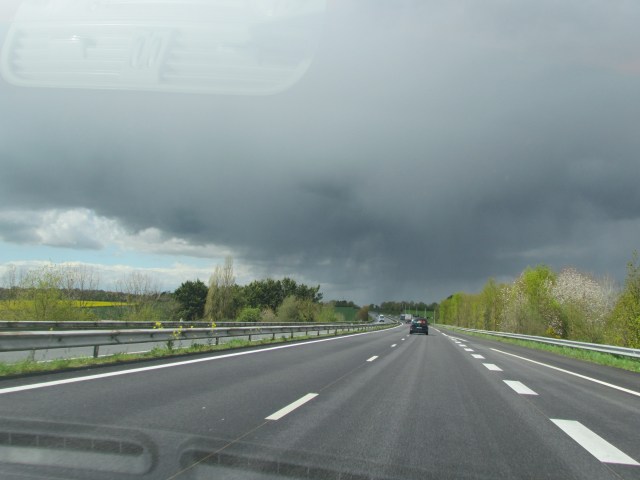
The weather changed several times during our drive. It would be sunny, then it would cloud up.


Sometimes the cloud would look very strange, with a combination of clear and stormy.
Sometimes the clouds would look very strange, with a combination of clear and stormy.


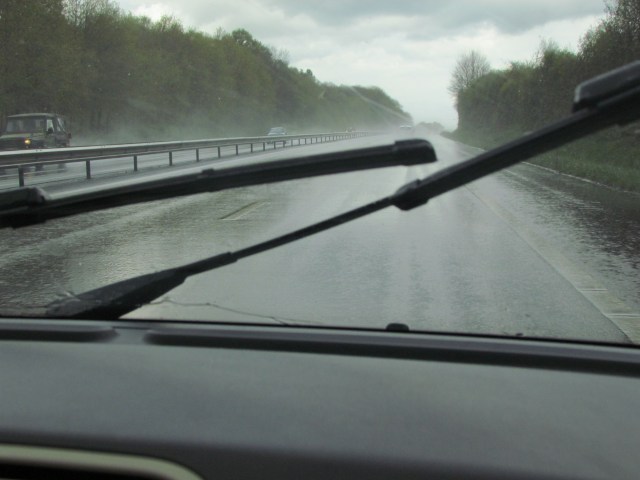
And then out of almost nowhere it would start to pour down rain. It looked like there should be thunder and lightening, but there never was. These almost daily spring showers here are what keep this place so incredibly green.
And then out of almost nowhere it would start to pour down rain. It looked like it should thunder and lightening, but it never did. These almost daily spring showers here are what keep this place so incredibly green.


The countryside is a combination of incredible green pastures and groves of trees like this one which has clearly been planted.


Time to put gas in our car - not because we needed it but just because it seemed like the right thing to do. (Hmmm...this is interesting - and in French!)
Time to put gas in our car – not because we really needed it but, well,  just because. (“Hmmm…let’s see here…this is interesting – and in French!”)


This is the gas station's restaurant/store.
This is the entry to the gas station’s restaurant/store.


The restaurant/store in the gas station was amazing. Down at one end there was this whole bank of elaborate coffee machines.
This restaurant/store was amazing. Down at one end there was this whole bank of elaborate coffee machines.


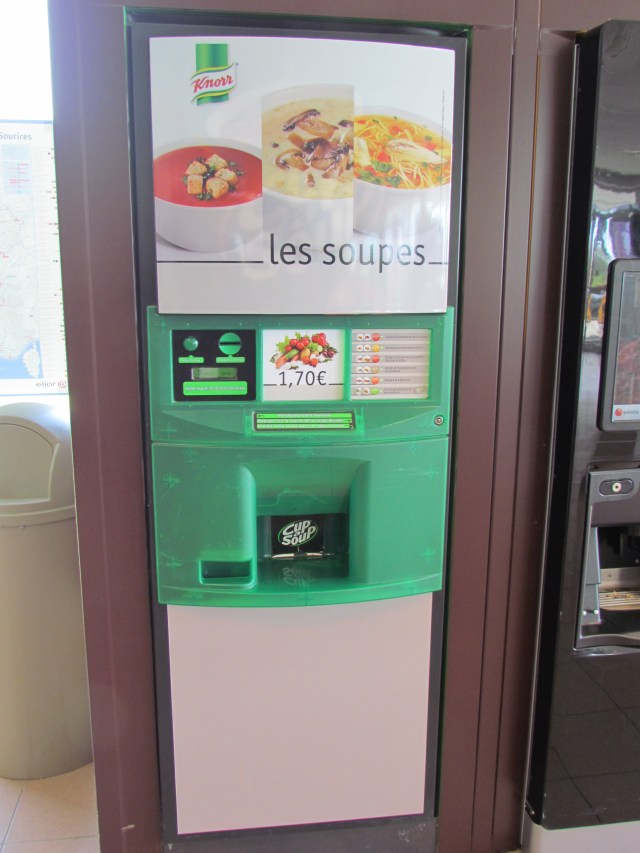
At the end of the row of coffee machines was a soup machine. We need one of these at work!


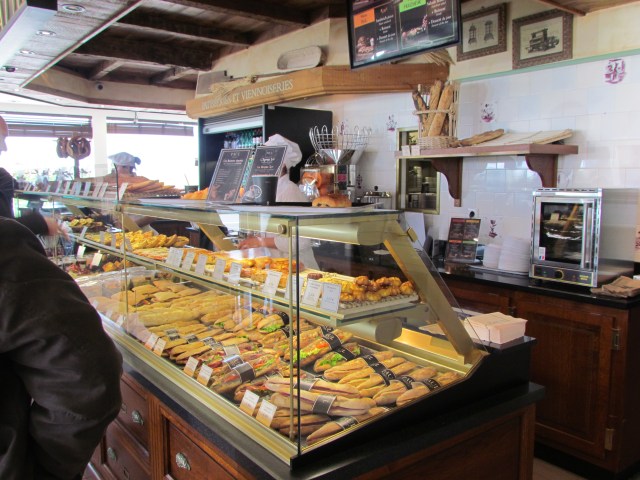
And at the other end of the store was this restaurant with lots of French (if course!) pastries and other great looking dishes that they would professionally heat for you. Through the back door you could even see the racks of their big ovens with pastries baking on them. And it smelled wonderful in there!
And at the other end of the store was this restaurant with lots of French (of course!) pastries, sandwiches, quiches, and other great looking dishes that they could heat for you. Through a door you could even see the racks of their big ovens with pastries baking on them. And it smelled incredible in there!


The speed limits vary on the roads from about 50 kilometers per hour (30 miles/hr) to 130 kilometers per hour (80 miles/hour). And they push it to the limit. Most towns have electronic speed indicators like you see in the U.S. but these have the addition of a smiley face or a sad face shown below your speed depending upon whether or not you’re speeding.

We’ve also noticed an abundance of rest areas along the highway. Usually there’s a rest area at least every 10-15 miles. Some of them are old and some are very new and they each have their own unique personality. Most of them have separate entrances for trucks and cars and most of the facilities aren’t large. And there are no vending machines. We stopped at 2 of them so of course I took some pictures.


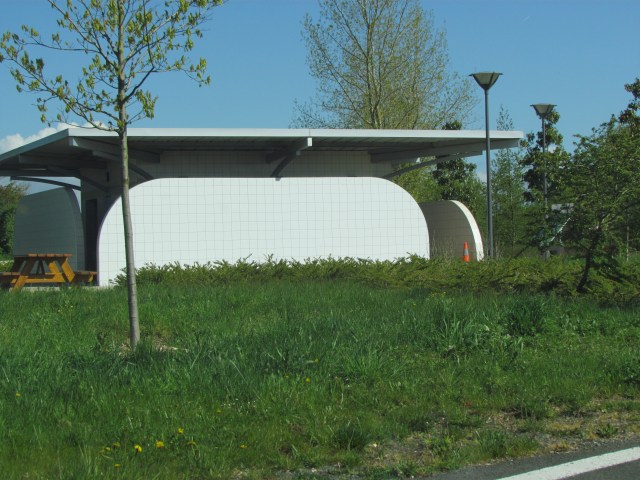
One of them that we stopped at was newer and the building looked very modern.


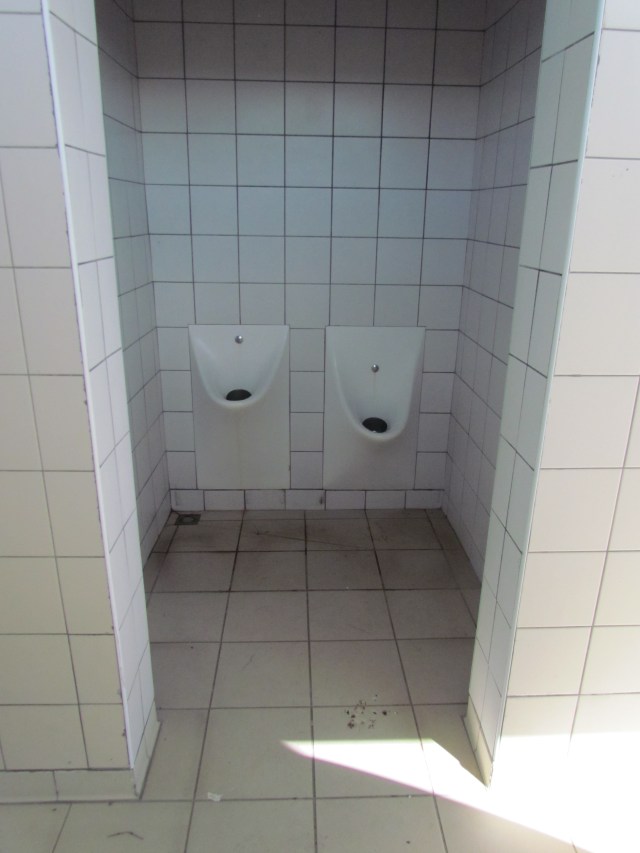
There are 2 urinals and they are on the outside of the building.. You just step into them but they're visible from outside.
There are 2 urinals and they are on the outside of the building.. You just step into them but they’re visible from outside.


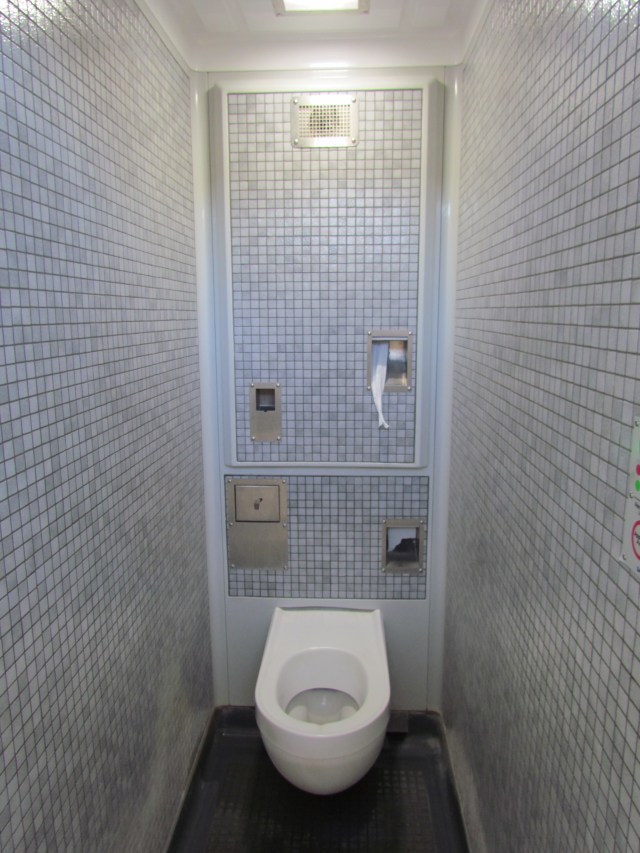
There were 2 doors to the outside marked for women and 2 marked men. But the insides looked exactly the same. It's wet inside when you enter because when somebody leaves it sprays the entire room with disinfectant.
There were 2 outside doors marked for women and 2 marked for men. But the insides looked exactly the same. It’s wet inside when you enter because after somebody leaves it sprays the entire room with disinfectant.


A little seating area was next to the building and several plaques around had an environmental theme to them. I think.


Freeway overpasses came in 2 varieties. The first was the usual variety where you can see cars passing overhead. The 2nd type was like this where you couldn't see through them, they had trees planted on them, and they were intended for animals to use to cross safely over.
Freeway overpasses come in 2 varieties. The first is the usual variety where you can see cars passing overhead. The 2nd type is like this one where you can’t see through them and  they have trees planted on them.  They allow animals to safely cross over.


And then there are those gorgeous yellow fields everywhere. If it is sunny in some areas and cloudy in others, you can be sure the sun will be shining on the yellow fields and they just glow! When seen close up, they’re about 3 feet tall and they are indeed the “wild mustard” we see at home in the canyons this time of year. They’re very pretty, but they’re weeds. I’m so glad somebody has finally legitimized them. I’ll probably never look at those weeds the same way again.

IMG_1140[1]

IMG_1139[1]
IMG_1117[1]
IMG_1107[1]
IMG_1106[1]IMG_1087[1]

IMG_1046[1]

And then we arrived at Mont St. Michel1
And then we arrived at Mont St. Michel!

Beautiful Chateau de Cheverny

We’ve visited 4 chateaux so far and they’ve all been very different from each other.  Yesterday after we visited the chateau at Chenonceau in the morning, we stopped at the Chateau de Chambord in the afternoon.  I probably won’t do a post on it because we were disappointed in it and it would be hard to do a good post on it.  It’s by far the biggest one we’ve seen, but the chateau is under renovation with scaffolding everywhere, there’s major construction of other tourism-oriented buildings around it, the grounds are a work in progress, and the castle itself is sparsely  and unimaginatively furnished.  And besides that, Chuck had to pay .5 Euros (about $.60) to use an outdoor porta-potty! Now how bad is that!
But the good news is that today we visited the Chateau de Cheverny, and it’s the best one we’ve seen yet.  Besides the fun of watching the feeding of the hounds (described in another post), this chateau is an overall great place to visit.  Let’s begin with a little background on the Chateau at Cheverny:

The chateau at Cheverny was built between 1624 and 1630 by the Henri Hurault family. During the next 150 years, ownership passed through many hands and in 1768 a major interior renovation was undertaken.  The Hurault family bought it back in 1825 and in 1914 the owner opened the chateau to the public, one of the first to do so. The Hurault family still operates it, and the current resident, the marquis de Vibrayek, is a direct descendant of Henri Hurault, the chateau’s builder.  Chateau Cheverny remains a top  tourist attraction to this day, renowned for magnificent interiors and its collection of furniture, tapestries and objets d’art.


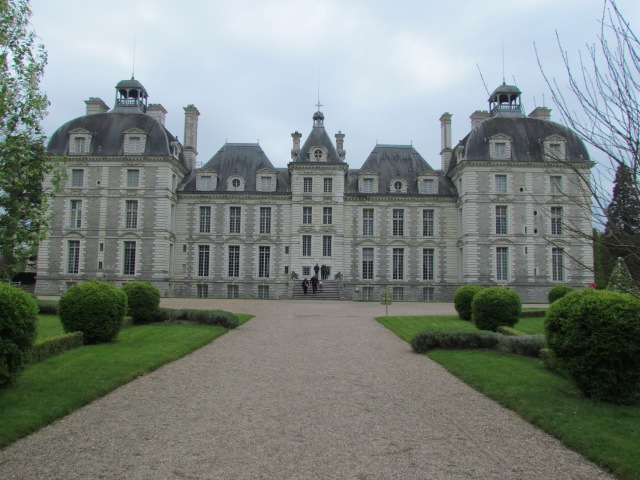
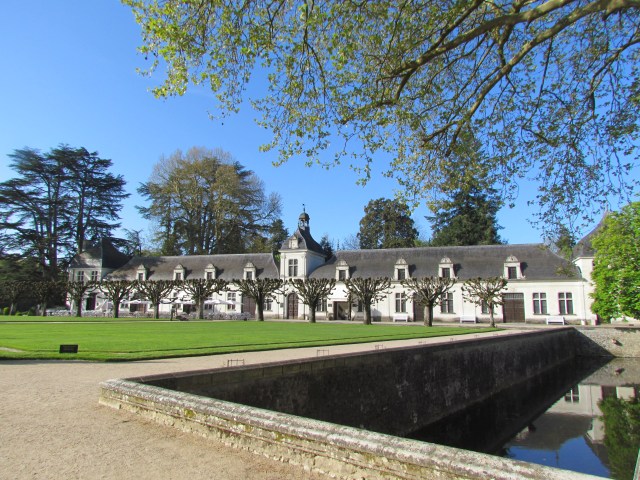
This is the back side of the chateau which interestingly looks exactly like the front side except that there's more landscaping on the back side.
This is the back side of the chateau which interestingly looks exactly like the front side except that there’s more landscaping on the back side.


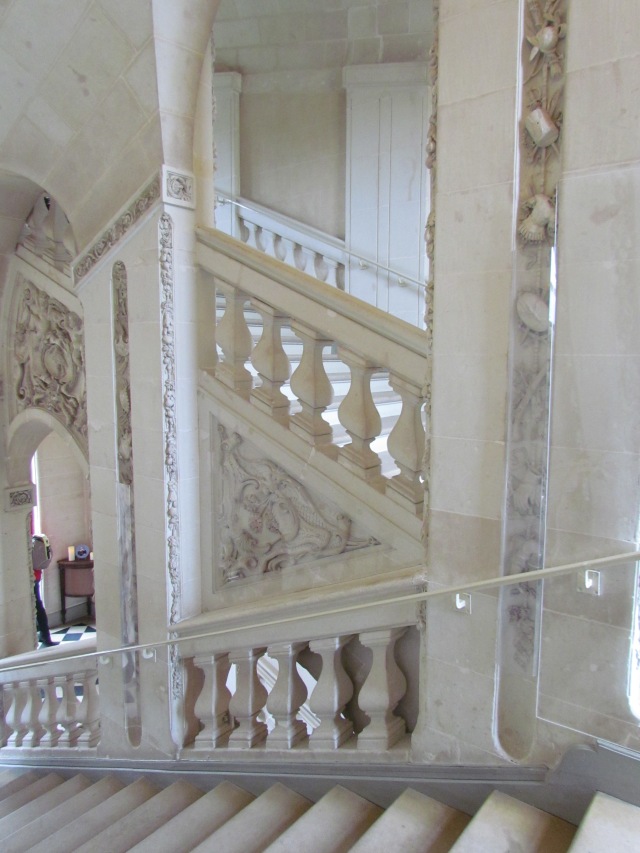
One of the beautiful marble staircases between the four stories.
Typical of Louis XIII style, the main staircase is carved stone and straight and with landings rather than a spiral. It shows the Italian influence common in the Loire Valley.


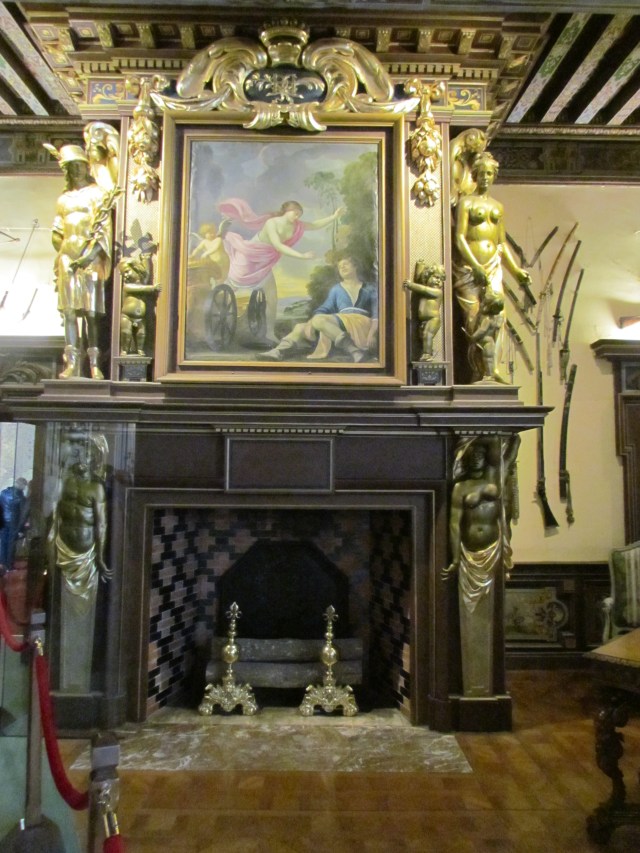
The fireplace on the end of the dining room was gigantic.
This fireplace was on the end of the arms room, the biggest room in the castle.


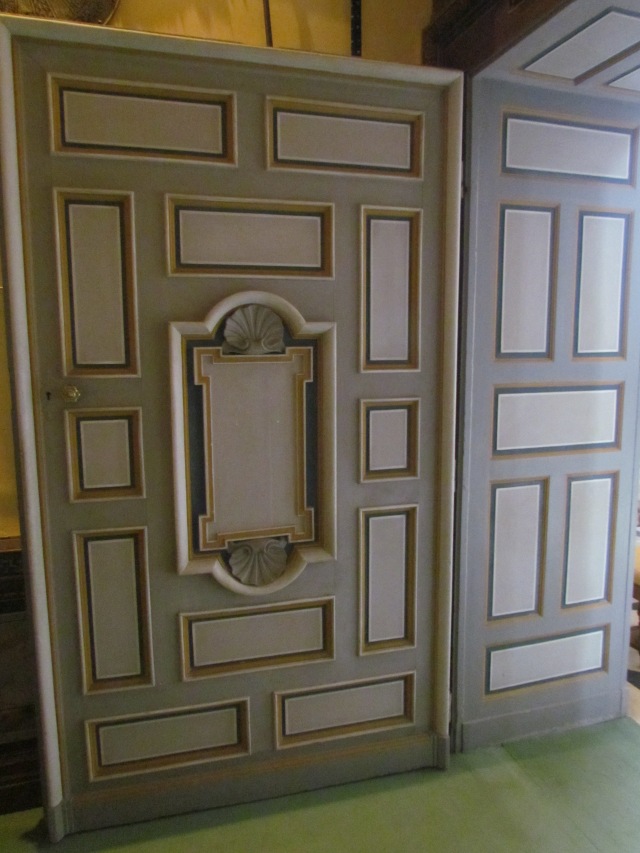
Beautiful and unusual doors and doorframes .


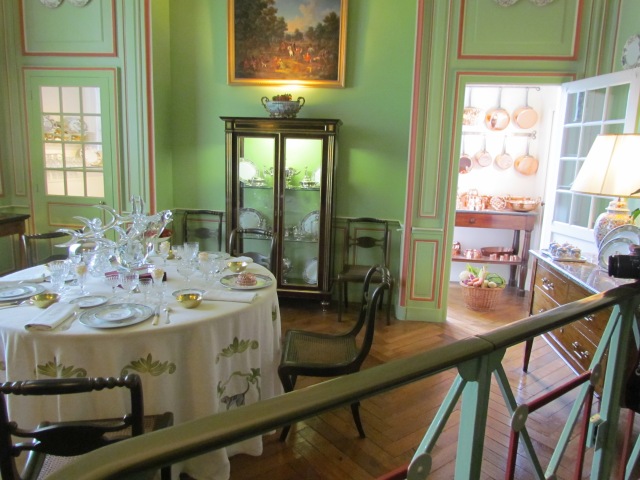
This bright and cheerful breakfast room was off the kitchen.


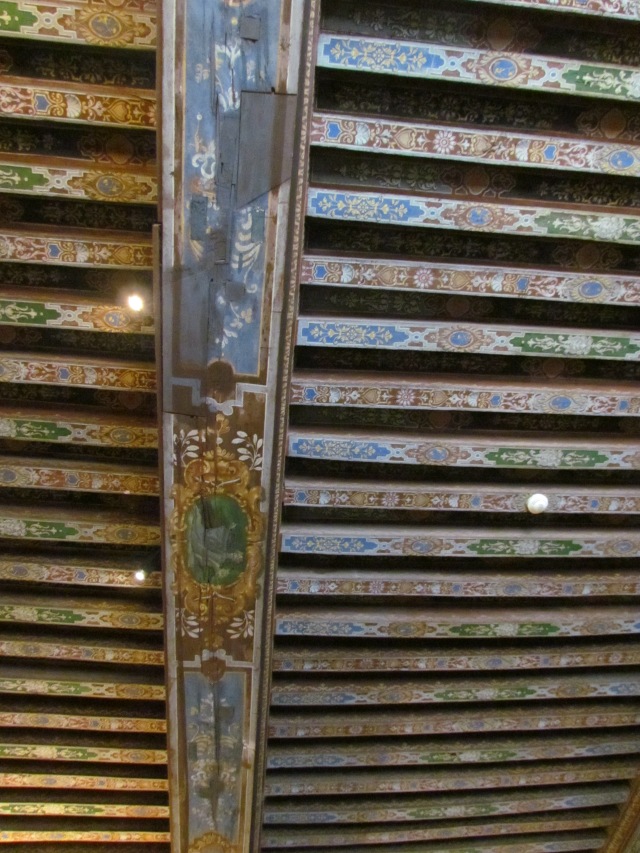
Most of the ceilings looked like this with colorful artwork on the tiny strips of wood.


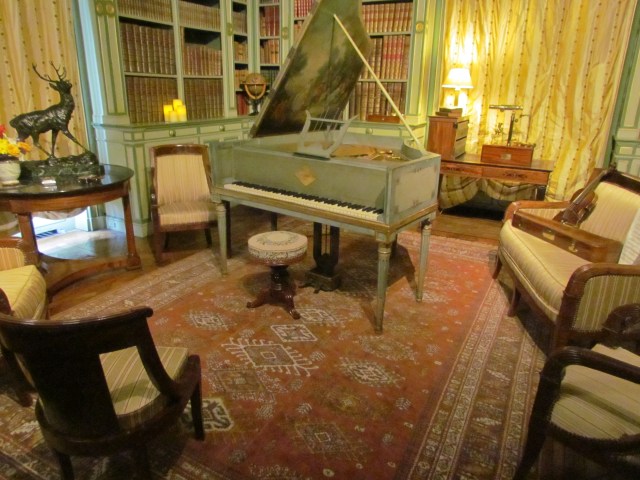
This was the music room. Notice the artist's painting on the inside of the piano lid.
This was the library/music room. Notice the artist’s painting on the inside of the piano lid. There are over 2,000 books in the library.


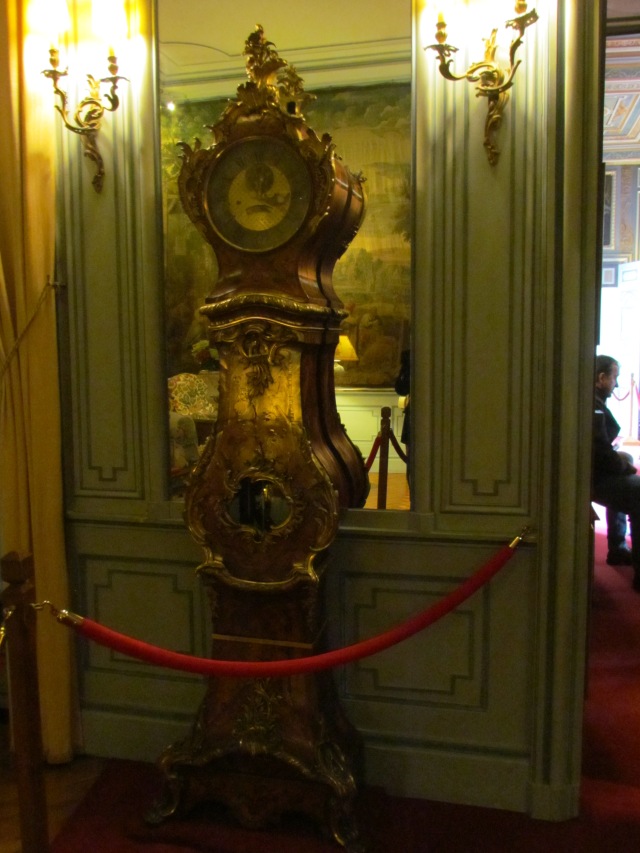
This regulator clock from the Louis XV period is decorated with bronzes and still in working condition. It marks the hours, minutes, and seconds, as well as the day, date and phases of the moon.
Not a great photo because of the poor lighting, but this regulator clock from the Louis XV period is decorated with bronzes and still in working condition. It marks the hours, minutes, and seconds, as well as the day, date and phases of the moon.


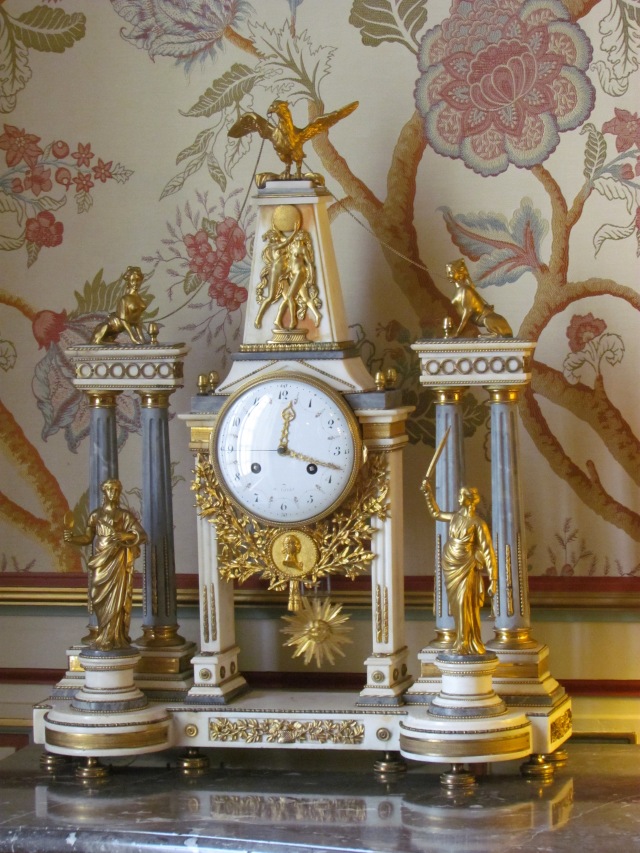
I know nothing about this clock except that I think it's beautiful and I want it.
I know nothing about this clock except that I think it’s beautiful and I want it. (I like the wallpaper too.)
 

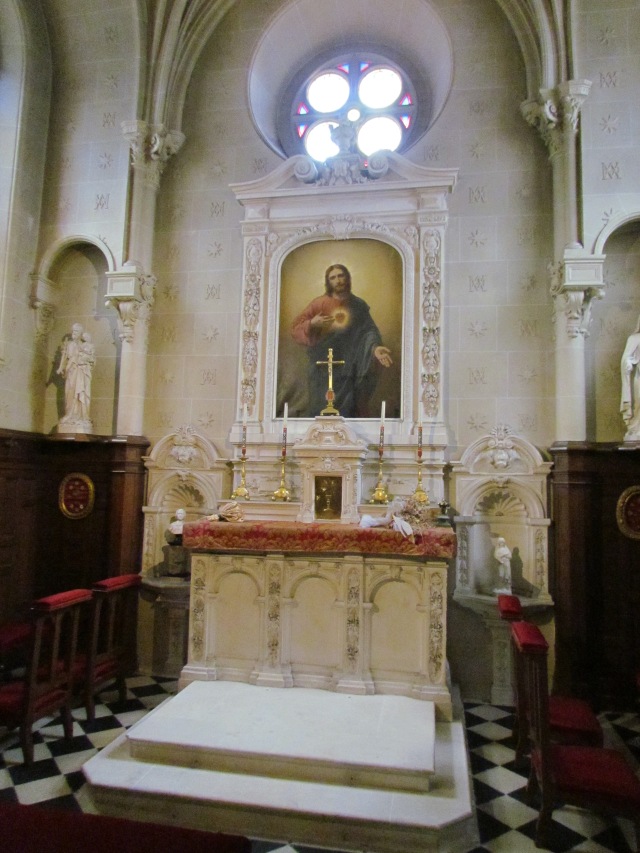
This tiny chapel on the 4th floor is square and has only one pew. Stained-glass windows were added in the 19th century.


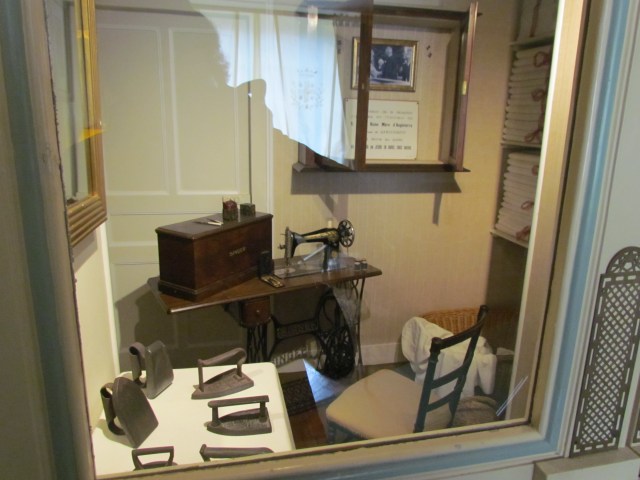
This tiny sewing room could be seen in the private apartments.
This tiny sewing room could be seen in the private apartments wing of the chateau..


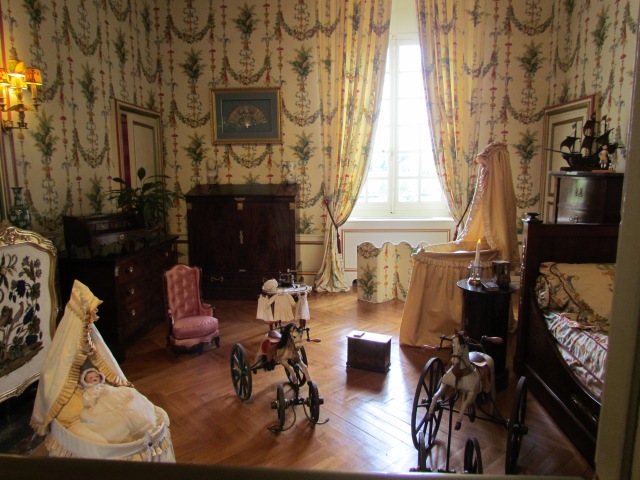
This beautiful nursery has matching wallpaper, drapes and bedspread. In the foreground are the first rocking horses from the time of Napoleon III.


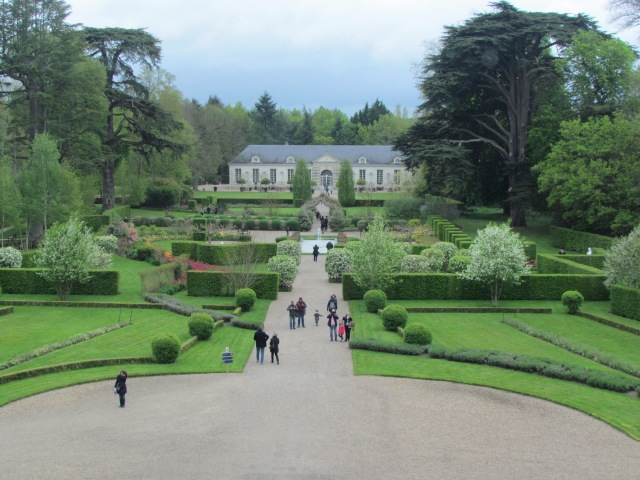
Looking out from the back of the residence, we see The Orangery. This 18th century building was used to keep the orange trees under shelter in winter. Today it is used as a café for chateau visitors.
Looking out from the back of the residence, we see The Orangery. This 18th century orangery was used to keep the orange trees under shelter in winter. Today the building is used as a café for chateau visitors.


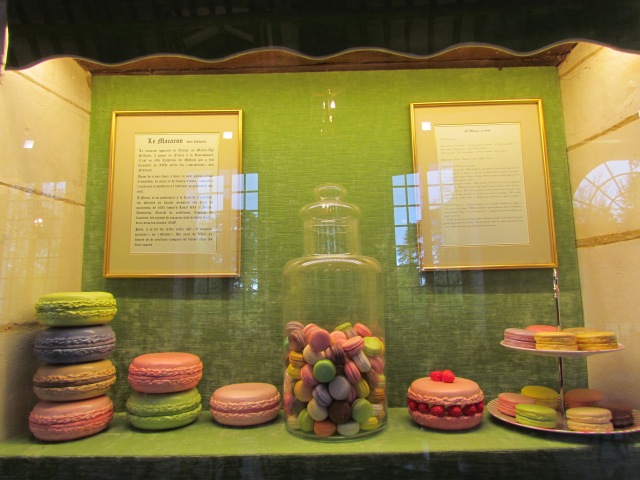
Inside the Orangery was this cute wall display of macaroons.


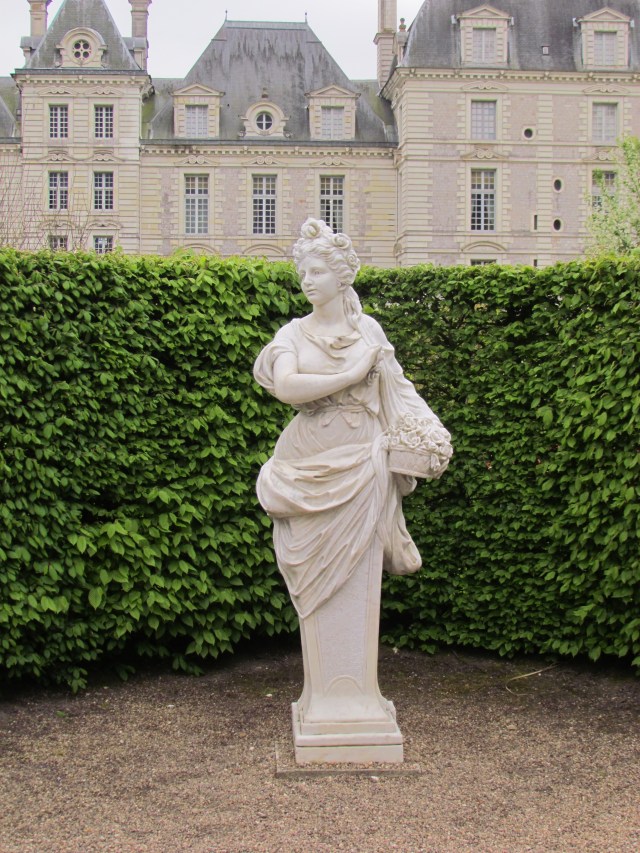
Between the castle and the Orangery is the Apprentices' Garden. This beautiful statue was in the garden and was strangely the only statue seen on the property.
Between the castle and the Orangery is the Apprentices’ Garden. This beautiful statue was in the garden and was strangely the only statue seen on the property.


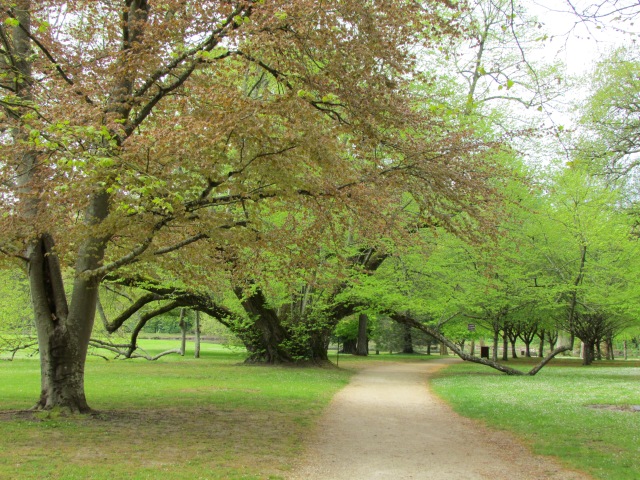
The grounds were beautiful - very green and park-like. This octopus-like tree was huge and amazing.
The grounds were beautiful – very green and park-like. This octopus-like tree was huge and amazing.


There was a lake at one side of the property and it was inhabited by black and swans and a variety of ducks.
There was a lake at one side of the property and it was inhabited by black and white swans and a variety of ducks.


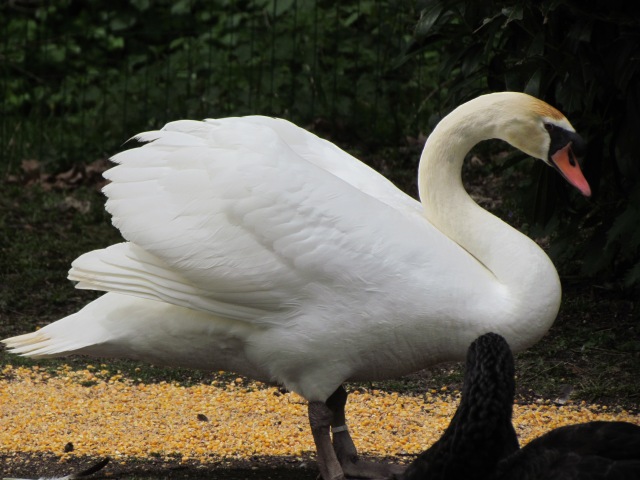
There were 2 huge white swans that were beautiful but cranky. One was sitting on a nest and the other one terrorized the smaller black swans.
There were 2 huge white swans that were beautiful but cranky. One was sitting on a nest while the other one terrorized the smaller black swans.


We also got to take a drive in the woods that are connected to the property. They took us out in little 8-passenger golf carts. At one point a woman spotted something in the woods and yelled and everybody got out and looked and talked about it a lot. Then everybody got back on the golfcart and the driver said, "Oh that's right, you don't speak French so you don't know what she saw!" And we still don't.
We also got to take a drive in the woods that are connected to the property. They took us out in little 8-passenger golf carts. At one point a woman spotted something in the woods and screamed and everybody got out and looked and talked about it a lot. Then everybody got back on the golfcart and the driver said in broken English, “Oh that’s right, you don’t speak French so you don’t know what she saw!” And we still don’t.


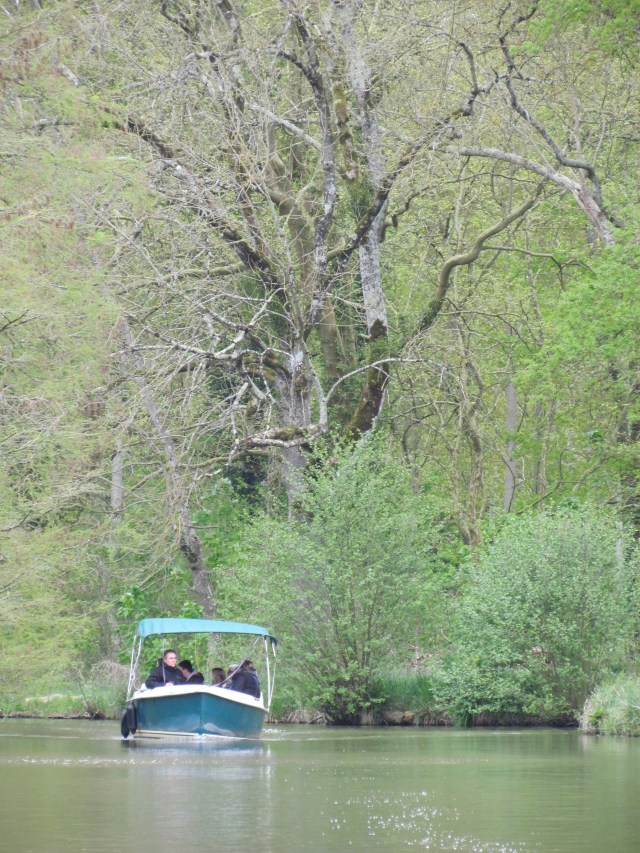
The golfcart took us down to their canals which were originally irrigation canals. We got on a boat and went through the canals. I'm sure it was very interesting - it was mostly in French.
The golfcart took us down to their canals which were originally irrigation canals. We got on a boat and went through the canals. I’m sure it was very interesting – it was almost entirely in French.


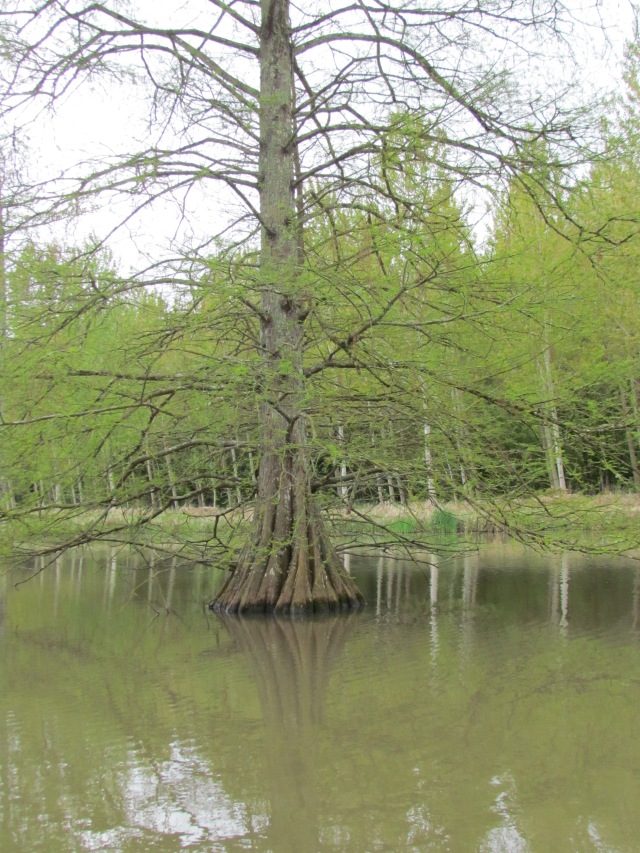
These trees growing in the canals are cypress trees like we see in Louisiana.
These trees growing in the canals are cypress trees like those we see in Louisiana.


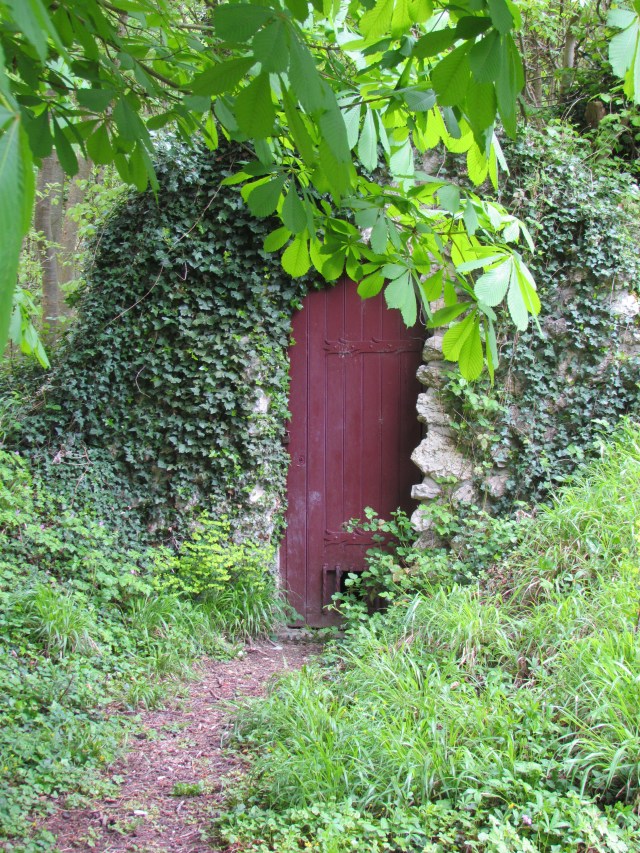
This little door down by the lake was so inviting. I wonder what elves lived here?


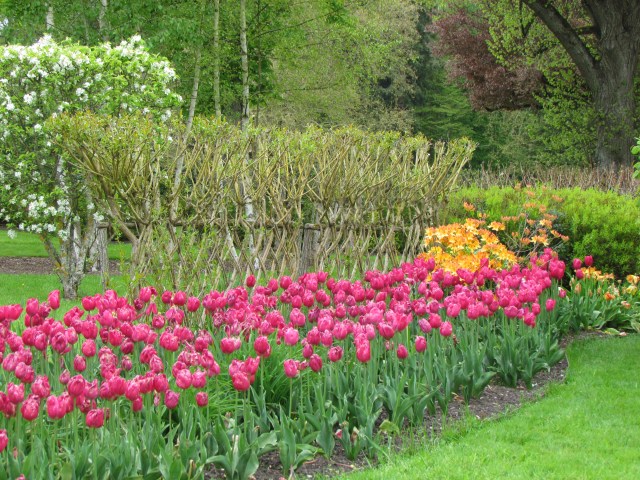
After the day was over, it was the gardens that we liked the most. Of course.


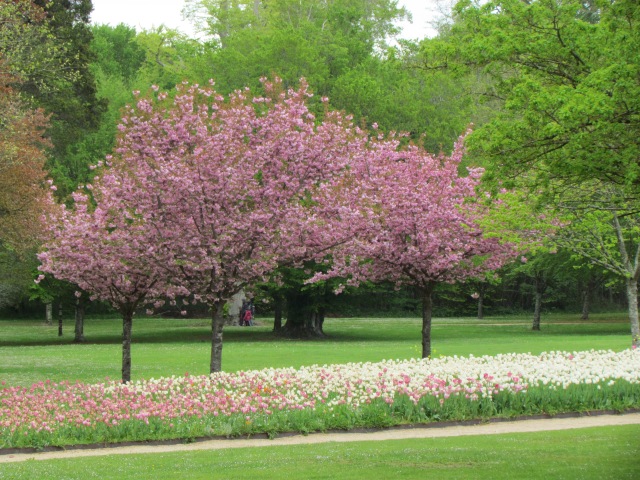
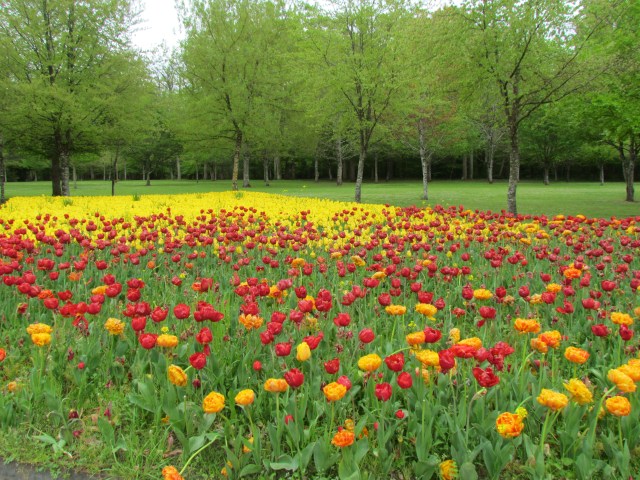
These trees with the matching tulips underneath were so pretty.


The chateau plants over 100,000 tulip bulbs every year and they were beautiful.

Feeding the Hunting Hounds at Chateau de Cheverny

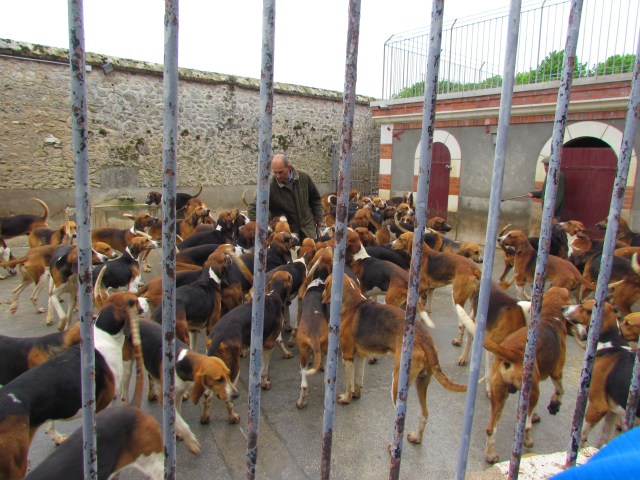
We made the 1-hour drive over to Cheverny to check out the Chateau and gardens (more about that in a separate post) and see if we could catch the daily feeding of the hounds.  Cheverny is famous for its kennels and the approximately 100 French hounds, a cross-breed of English fox hound and the French Poitou, that occupy them. The hounds are taken out for hunts twice weekly, but the chateau is probably best known for its 11:30 daily public feeding, especially popular with tourists.
 

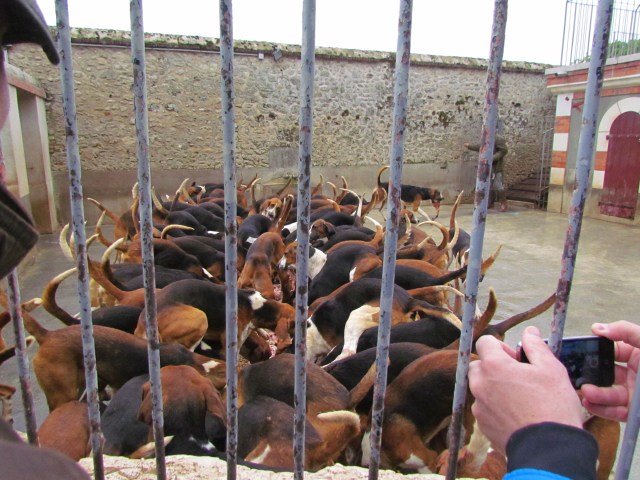
Dogs run around in the enclosure, greeting visitors outside the fence, wagging their tails, and playing with one another.
Dogs run around in the enclosure, greeting visitors outside the fence, wagging their tails, and interacting with one another.


The handlers work with the dogs in the enclosure. They isolate about 20 of the dogs, one by one, and take them by the scruff of the neck and put them back in one of the doors.
The handlers work with the dogs in the enclosure. They isolate about 20 of the dogs, one by one, and take them by the scruff of the neck and put them through the door into the building.


Next the handlers open the gate next to the building and the dogs all run through the gate and up the stairs onto the balcony. And they watch the handlers' every move. They are giddy with anticipation. The handers wash down the area with buckets of water while the dogs watch.
Next the handlers open the gate on the left side of the building and the dogs all run through the gate and up the stairs onto the balcony. And they watch the handlers’ every move. They are giddy with anticipation. The handers wash down the area with buckets of water while the dogs watch.


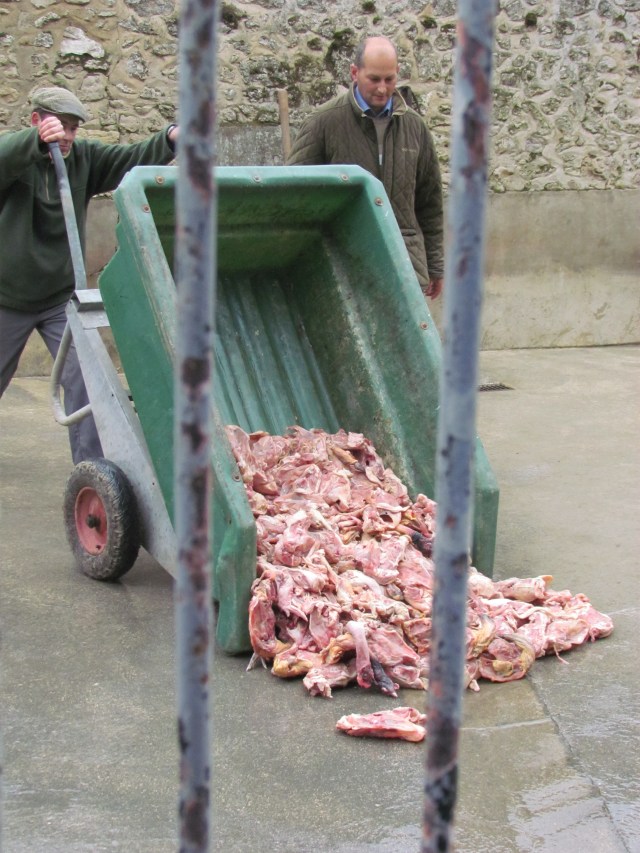
Next they dump a push cart filled with raw meat onto the freshly washed concrete floor.


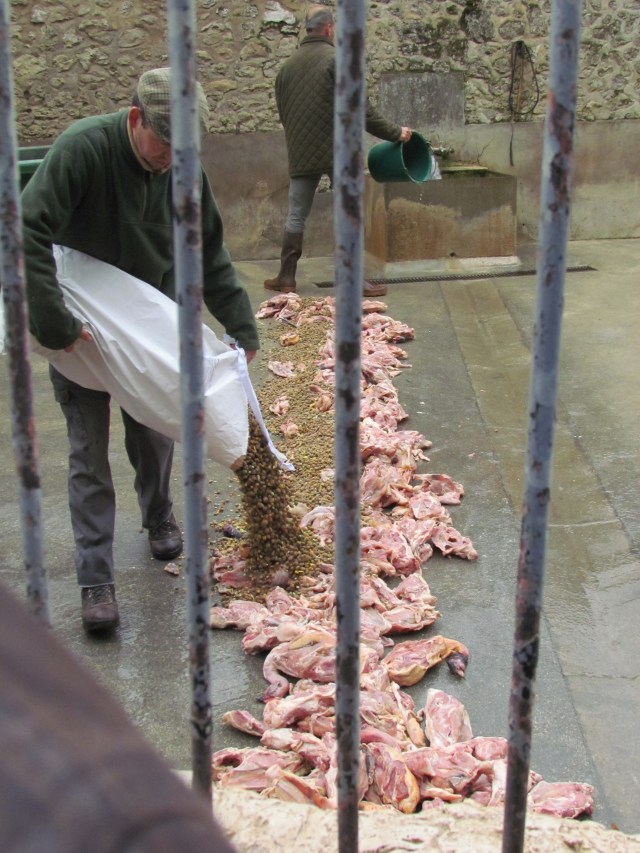
After raking the meat out into a line across the area, they cover it with dry dog food.
After raking the meat into a line across the area, they cover it with dry dog food.


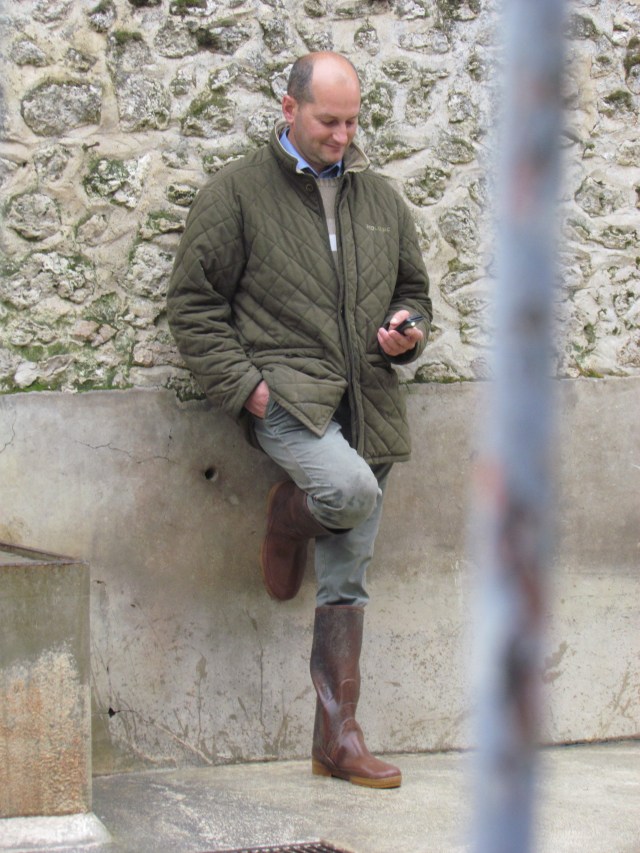
And then they wait. The dogs are quiet. The handler checks his cell phone for the correct time about 3 times.


When the time is right, the gate is opened and the dogs come down the stairs and flooding out.
When the time is right, the gate is opened and the dogs come rushing down the stairs and into the feeding area.


They know they're not allowed to eat until given the signal. They wait patiently for the signal. Well...somewhat patiently.
They know they’re not allowed to eat until given the signal. They wait patiently for the signal. Well…somewhat patiently.


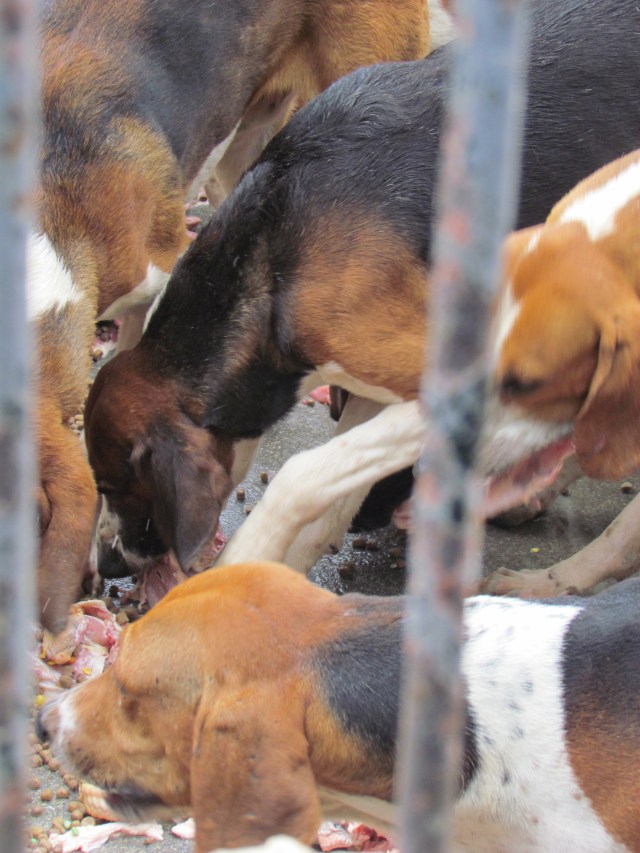
The signal is given and they all fly into the food with enthusiasm.


The dogs are all over each other and the food. When the raw meat is mostly gone and they're down to the bagged dog food, the handlers let out the other dogs that had been cut out of the pack. We have no idea what the story is with these 20 or so special dogs. Overall, the whole ordeal was fascinating to watch.
The dogs are all over each other and the food. When the raw meat is mostly gone and they’re down to the bagged dog food, the handlers let out the other dogs that had been cut out of the pack. We have no idea what the story is with these 20 or so special dogs. Overall, the whole ordeal was fascinating to watch.

Charming Chateau de Chenonceau

We made a trip to the Chateau de Chenonceau. But first let’s start with a little background:

The Chateau de Chenonceau spans the River Cher near the small village of Chenonceaux. Although it was first mentioned in writing in the 11th century, the current chateau was built in 1514-1522 on the foundations of an old mill and was later extended to span the river, although there is no opening to the other side of the river. It’s known as “Chateau de Femmes” or “the castle of 6 ladies” for the succession of powerful French noblewomen of Chenonceau, who each made an impact on the castle forming it into the lovely chateau it’s become today. Since 1913, the chateau has been privately owned by Henri Menier, a member of the Menier family famous for their chocolates. Other than the Royal Palace of Versailles, it is the most visited chateau in France, with over 1 million visitors each year.

The beautiful Chateau de Chenonceau spanning the Cher River.


We visited the beautiful Chateau de Chenonceau and were very impressed by both the presentation of the inside of the chateau as well as the extraordinary grounds and gardens. Six women have historically put their touch on the Chateau and its grounds; it clearly does have a woman’s touch and has been beautifully maintained as such. The rooms are perfectly presented, the audio guides are well done, and the fresh flower arrangements throughout the castle are either beautiful or interesting or both. In addition to the chateau, there’s a maze, 2 formal gardens, a 16th century farm which is connected to a vegetable and flower garden and a field full of donkeys. All in all, it’s a pretty cool place.

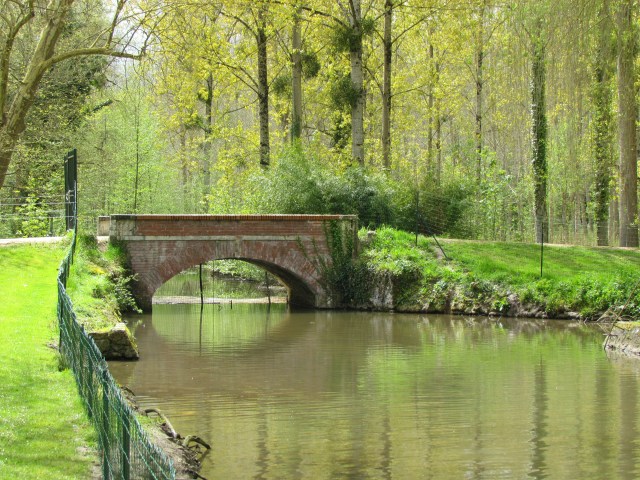
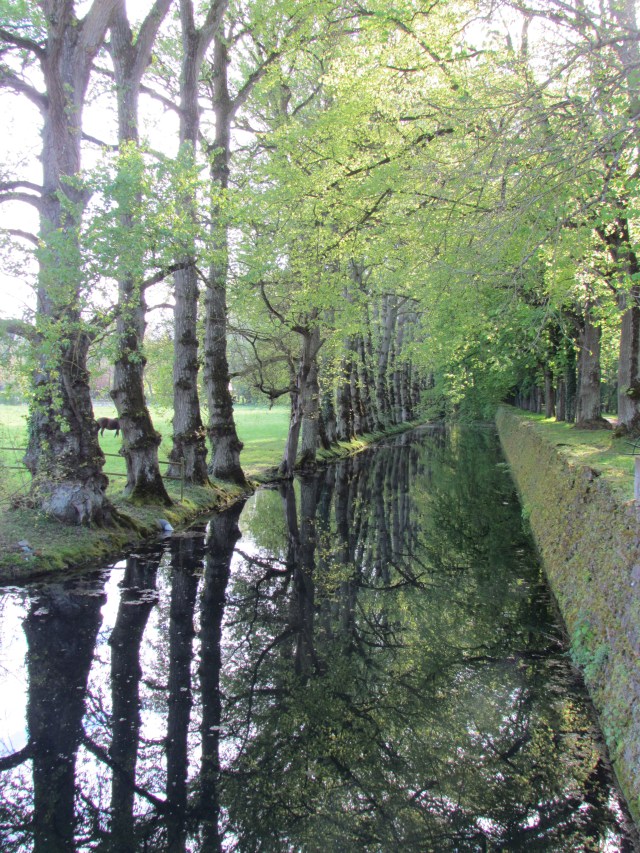
After leaving the parking lot, you are surrounded by beautiful wooded areas and canals that look like this one.


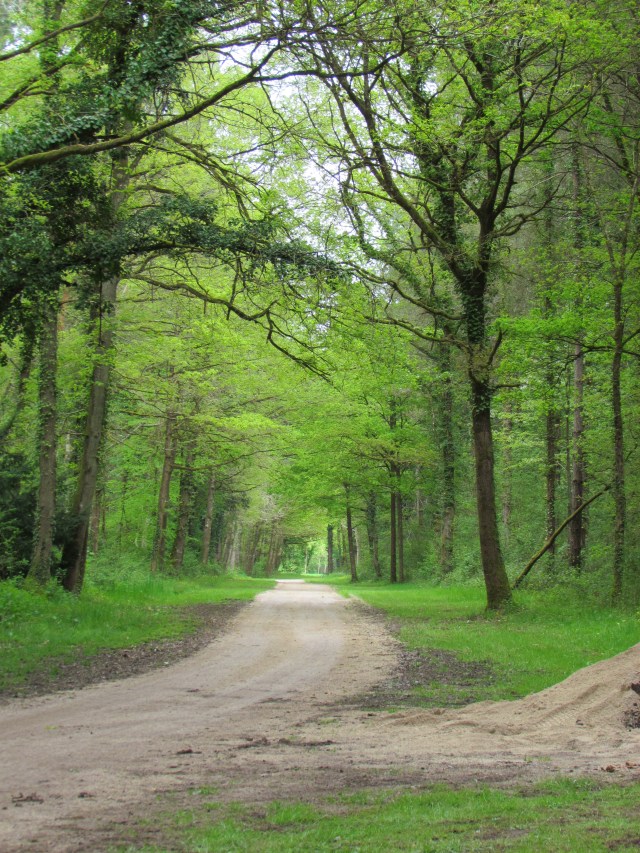
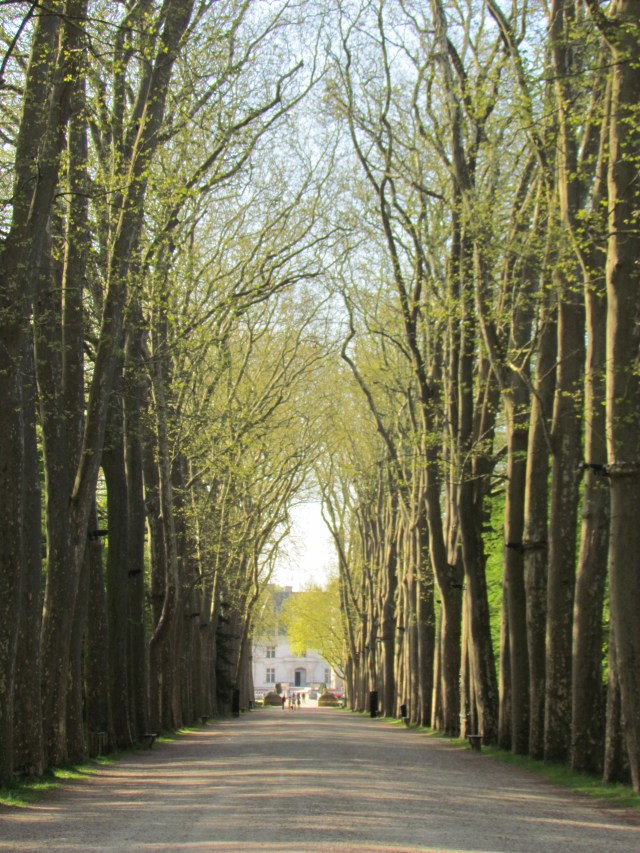
Motor vehicles are not allowed to get close to Chenonceau so you have to park and walk 1/4 mile down this road lined by this row of incredible trees. The trees are lit at night which must make for a pretty dramatic entrance.
Motor vehicles are not allowed near Chenonceau so you have to park and walk 1/4 mile down this road lined by a row of incredible trees. Way down at the end of the trees, the chateau is just becoming visible. The trees are lit at night which must make for an even more dramatic entrance.


This building previously housed stables but today contains a restaurant and pubic rest rooms. Stable stalls are now restaurant booths.
This building previously housed stables but today contains a restaurant and pubic restrooms. What were previously stable stalls are now restaurant booths.


Before crossing the moat to the castle, you come to the Marques tower which was the protective keep for the chateau.


Once inside the castle, the first room visited is this darling little chapel.


This was the bedroom of King Henri II's favorite lady, Diane de Poitiers to whom he donated Chenonceau. After his death, his wife made Diane give it back to her in a swap.
This was the bedroom of King Henri II’s favorite lady, Diane de Poitiers, to whom he donated Chenonceau. After his death, his wife made Diane give it back to her in a swap.


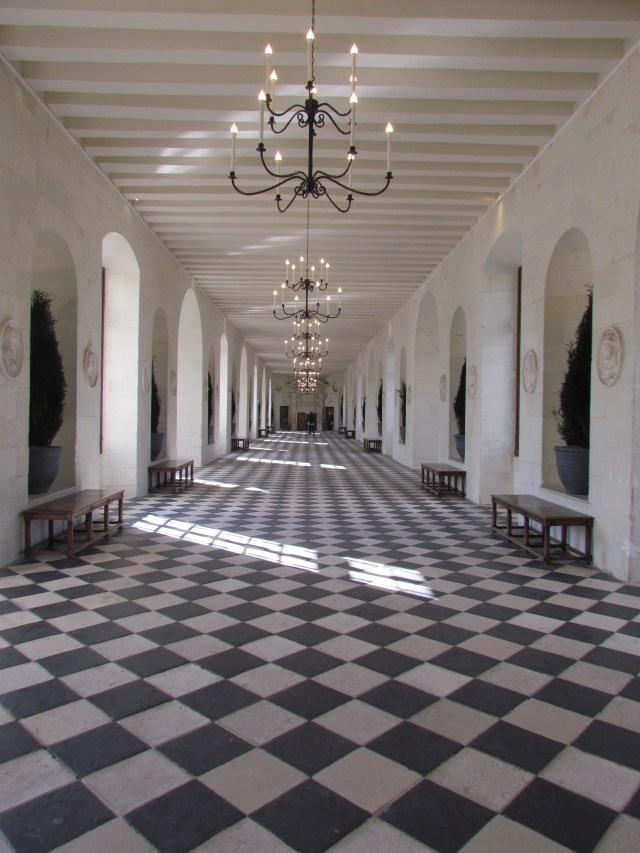
The castle was originally just the large part on the right side. Eventually Catherine had them continue it across to the other side of the river. In that first floor of that added portion was this Gallery. With a fire place on either end, it made a magnificent ball room.
If you look again at my original photo at the top of this post, the castle was originally just the large part on the right side. Eventually Catherine had them continue it across to the other side of the river. In the first floor of that added portion was this Gallery. With a fire place on either end, it made a magnificent ball room.


This fabulous piece of furniture is Italian but we couldn't find anything that said exactly what this is. A jewelry chest perhaps?
This fabulous piece of furniture is Italian but we couldn’t find anything that said exactly what this is. A jewelry chest perhaps?


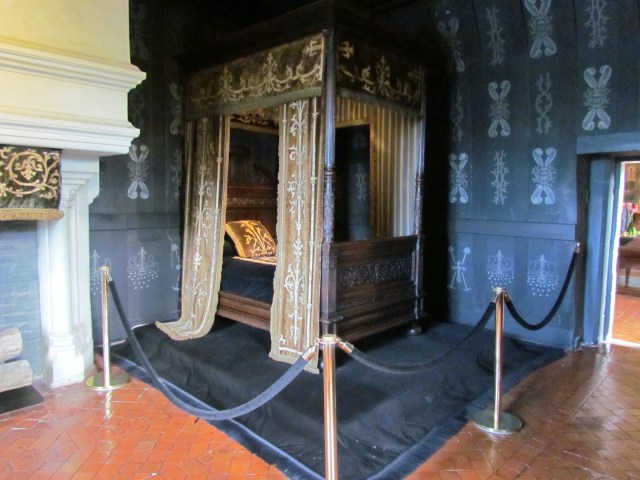
Louise of Lorraine retired to Chenonceau to meditate and pray after the assassination of her husband king Henri III. This was her room during that time of mourning.


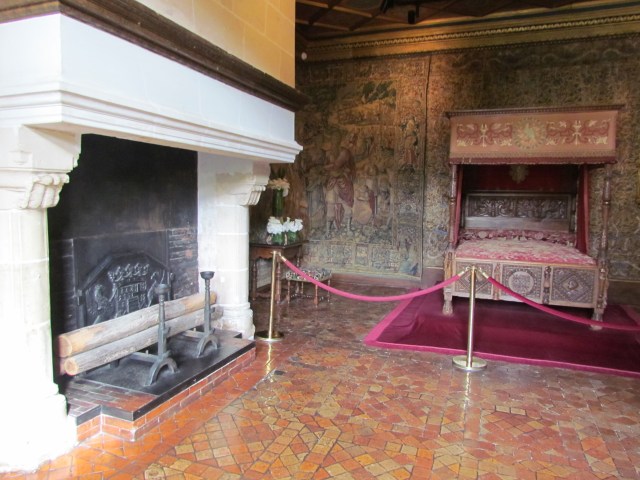
This bedroom with the wonderful tapestries on the walls belonged to Catherine De Medici, wife of Kind Henri II. The chateau has lots of amazing tapestries which are all nearly invisibly protected by glass.


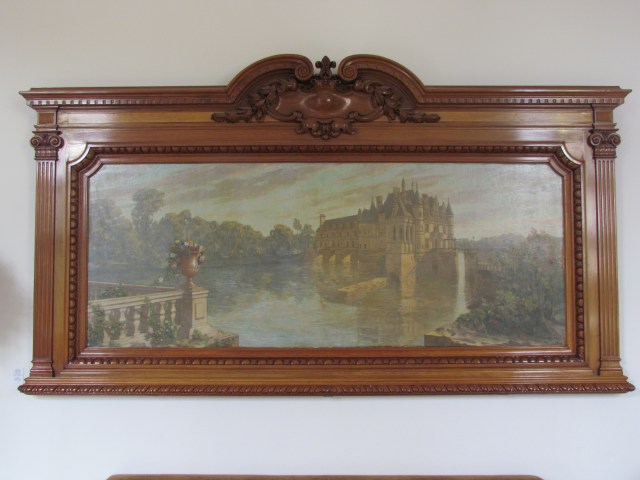
I liked this painting of the Chenonceau which was displayed on one of the walls.
I liked this painting of the Chenonceau chateau which was displayed on one of the walls.


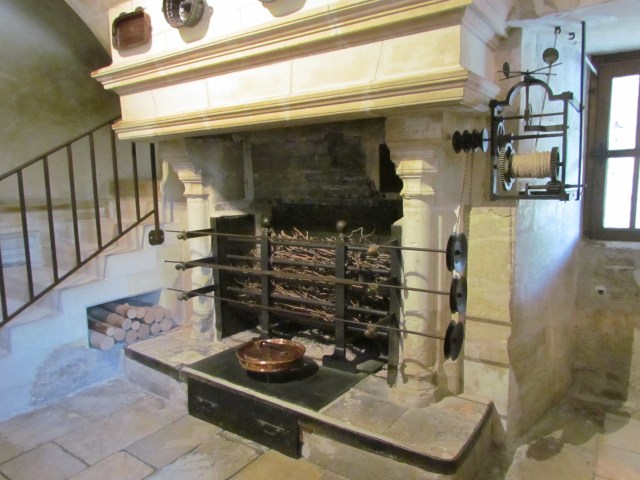
We got to go downstairs into the huge kitchen area - a fascinating place. This fireplace served as a rotisserie - you can see the robes for turning whatever was on the spit on the right side of the fireplace.
We got to go downstairs into the huge kitchen area – a fascinating place. This fireplace served as a rotisserie – on the right side of the fireplace you can see the ropes for turning whatever was on the spit.


The butchery area of the kitchen still has hooks for hanging game and blocks with knives hanging above it like this one which was big enough to butcher an entire animal.
The butchery area of the kitchen still has hooks for hanging game and blocks with knives hanging above it like this one which was big enough to butcher an entire animal on.


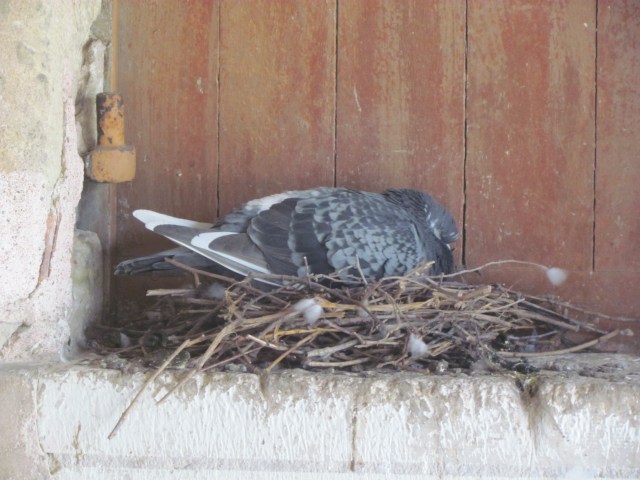
A nesting pigeon lived right outside one of the kitchen windows which was used to give access to transporting supplies from a boat into the castle.


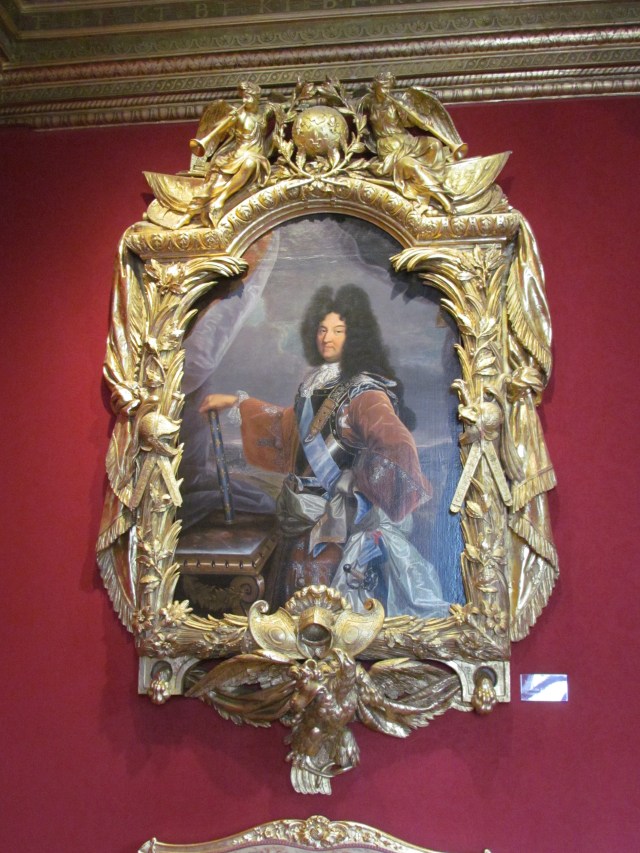
This portrait of Louis XIV was painted by Rigaud and was very striking. But the thing that was most impressive was the magnificently carved and gilded frame that it was in, which was done by Lepautre.
This portrait of Louis XIV was painted by Rigaud and was very striking. But most impressive was the magnificently carved and gilded frame that surrounded it which was done by Lepautre.

Interesting and beautiful flowers are everywhere in the chateau and lend a real personal touch to the space.


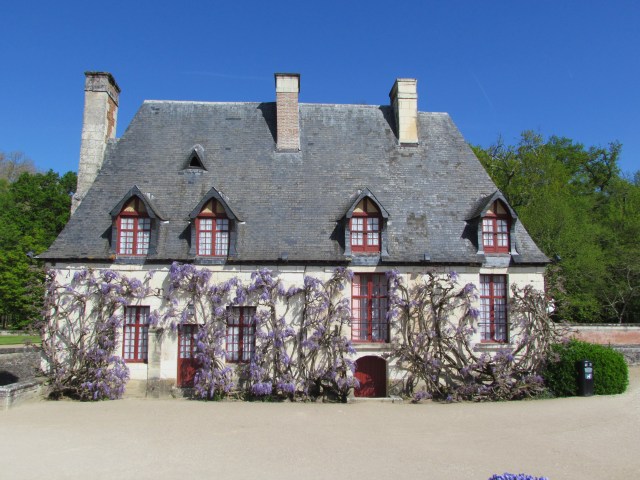
Just on the side of Diane;s Garden is this cute little house whose front side is covered by beautiful blooming wisteria. This house was the home of the chancellery, the estate steward.
Just on the side of Diane’s Garden is this cute little house whose front side is covered by beautiful blooming wisteria. This house was the home of the chancellery, the estate steward.


Diane's Gardens are covered with pink flowers and lots of beautifully manicured shrubs. It's an incredibly beautiful garden surrounded by a wall to keep out the water in case of river flooding.
Diane’s Gardens are covered with pink flowers and lots of beautifully manicured shrubs. It’s an incredibly beautiful garden surrounded by a wall to keep out rising water.


A moat surrounds the gardens and there was a cute little drawbridge over the moat.


Catherine de' Medici really, really wanted a maze so 2,000 yews were planted to make a maze. Except for the middle which is a bit elevated, the maze is trimmed to neck height making for an interesting view of people in the maze.
Catherine de’ Medici really, really wanted a maze so 2,000 yews were planted to make a maze. Except for the middle which is a bit elevated, the maze is trimmed to neck height making for an interesting view of people’s heads floating above the yews.


Behind the maze are 4 Caryatids: Pallas, Cybele, Hercules and Apollo.


The chateau and gardens were perfect: quiet, beautiful, and serene. And then there was this guy. . .

Chateau Royal d’Amboise

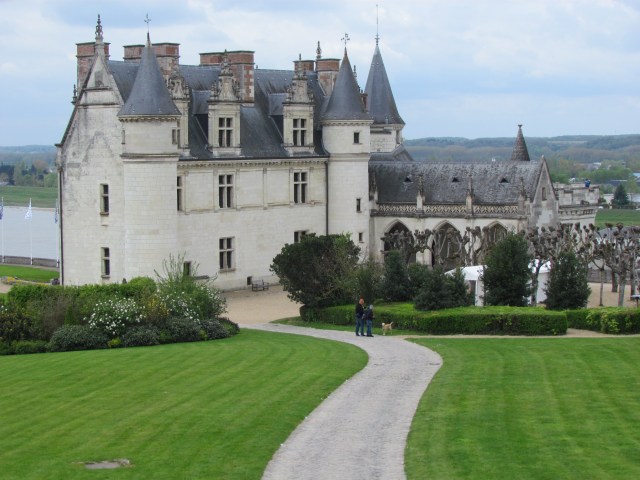
We spent the afternoon at the Chateau Royal d’Amboise.  First I’ll give a little background on the chateau, followed by the photos we took both inside the castle and on the beautiful, manicured grounds.

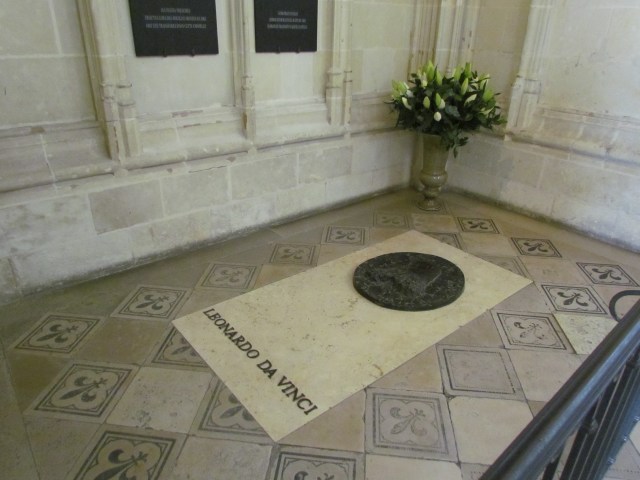
The royal Chateau at Amboise was built on a spur above the widest stretch of the Loire river. A medieval fortress has overlooked the Loire from here since roman times. It was replaced by a royal residence during the reigns of King Charles VIII and Francoise I in the late 15th to early 16th centuries. Probably its most famous resident was Leonardo da Vinci who came here in retirement and died here in 1519.  At his request da Vinci was buried within the royal chateau where his tomb can be found in Saint Hubert’s Chapel.

The chateau is immaculately groomed on the outside. The grounds are mostly green but there are exuberant flashes of color in the form of spring flowers placed strategically around the grounds.
The chateau and grounds are immaculately groomed on the outside.  Unlike some chateau’s gardens, the grounds are mostly green but there are exuberant flashes of color in the way of spring flowers placed strategically around the grounds. (just not in this photo).


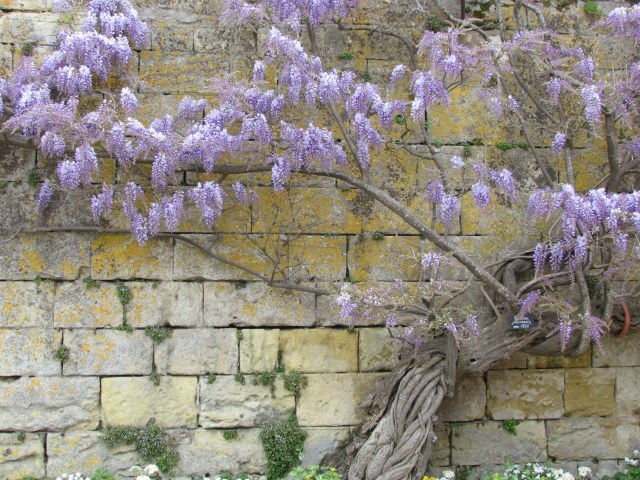
Coming up the ramp towards the chateau, we ran across this beautiful wisteria. A small sign on it says it's from 1840.
Coming up the ramp towards the chateau, we ran across this beautiful wisteria. A small sign claims the wisteria is from 1840.


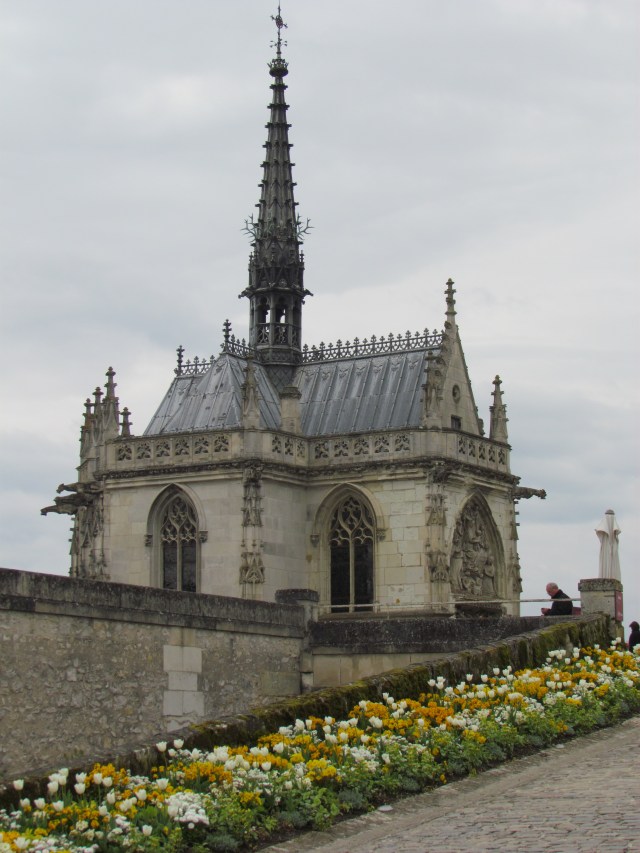
Saint-Hubert's Chapel was once part of a larger building. The Chapel is a tiny place with no seating but it is where Leonardo Da Vinci asked to be buried.
Saint-Hubert’s Chapel was once part of a larger building. The Chapel is a tiny place with no seating but it is where Leonardo Da Vinci asked to be buried.


Leonardo's Da Vinci's tomb.
Leonardo’s Da Vinci’s tomb.


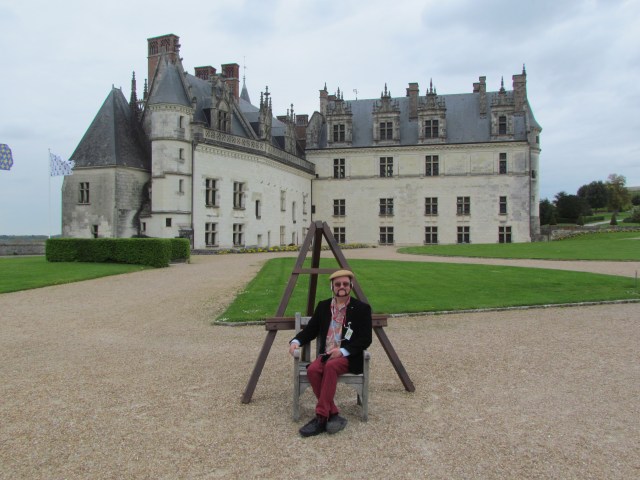
Chuck and I weren't really the only ones here today - I just got lucky.
This little photo op site was set up just outside of Saint-Hubert’s Chapel. Chuck and I weren’t really the only ones here today – I just got lucky with this photo.


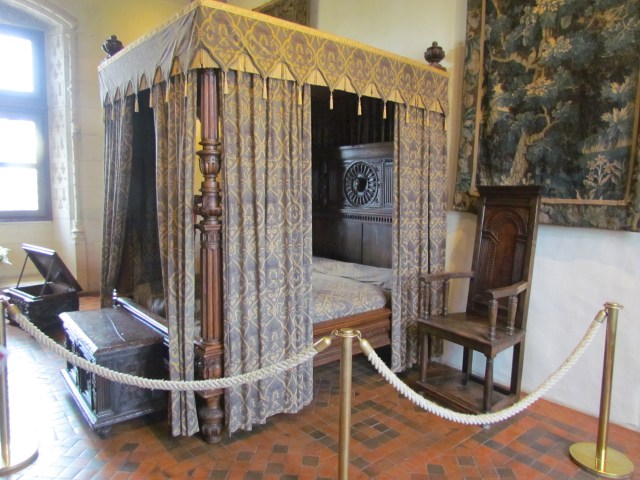
This beautiful bed was in Henri II's chamber in the mid-1500's.
This beautiful bed was in Henri II’s chamber in the mid-1500’s.


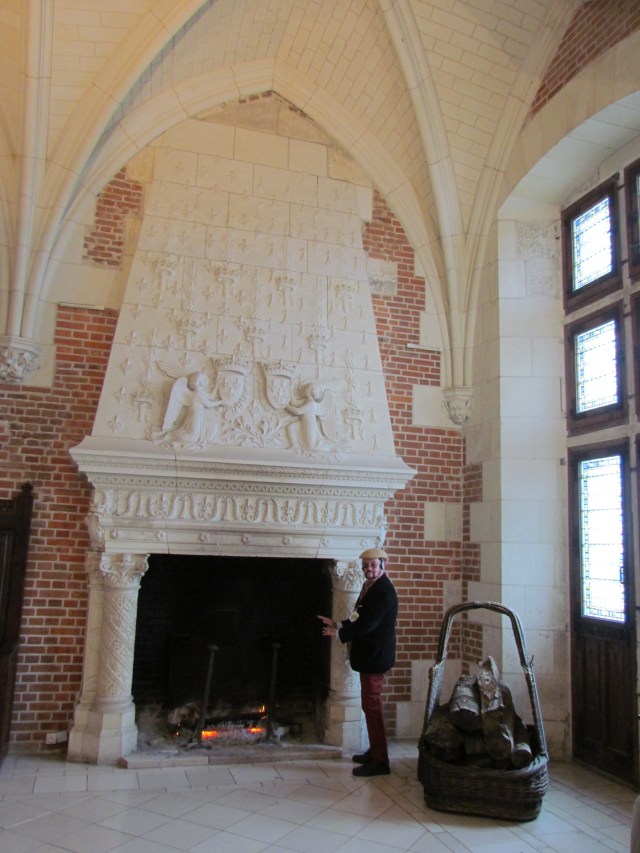
The council chamber was a gathering place for governors, officers and clerical dignitaries. We were surprised that there was an actual fire burning in the fireplace which amazingly warmed up the large, cold room.


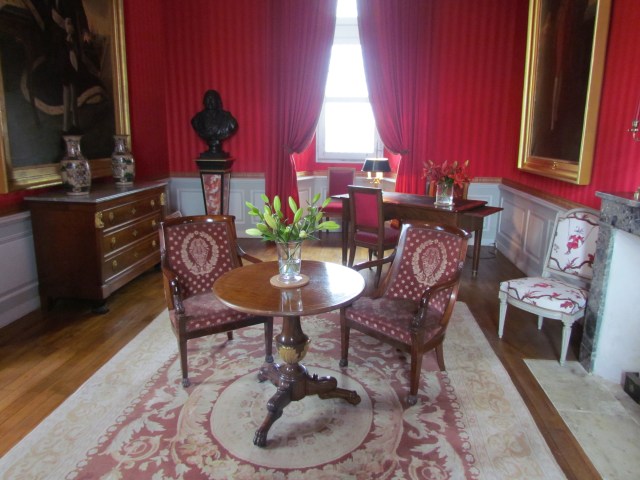
This beautiful red-wallpapered room was the Orleans-Penthievre Study.


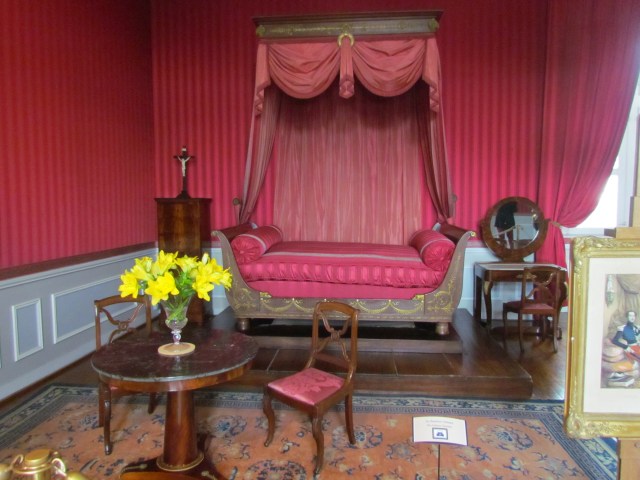
Next to the study, this bedroom was called the Orleans Chamber. Notice how the sleighbed is actually on 2 platforms.


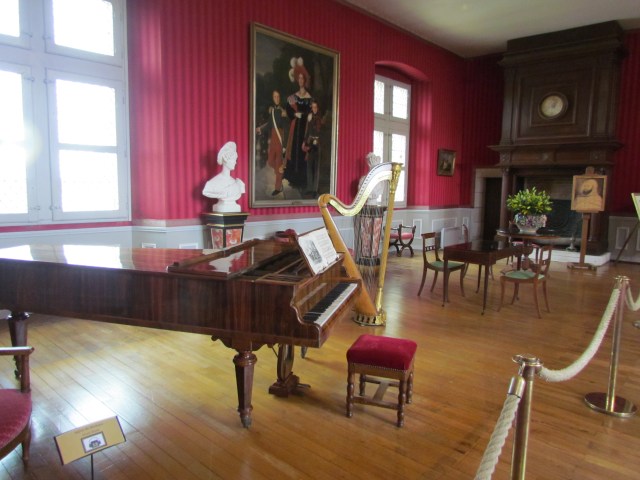
Next to the Orleans Chamber is the music room.


The sentries' walk was an open gallery where guards could observe boats on the river and the river crossing.
The sentries’ walk was an open gallery where guards could observe boats on the river and the river crossing.


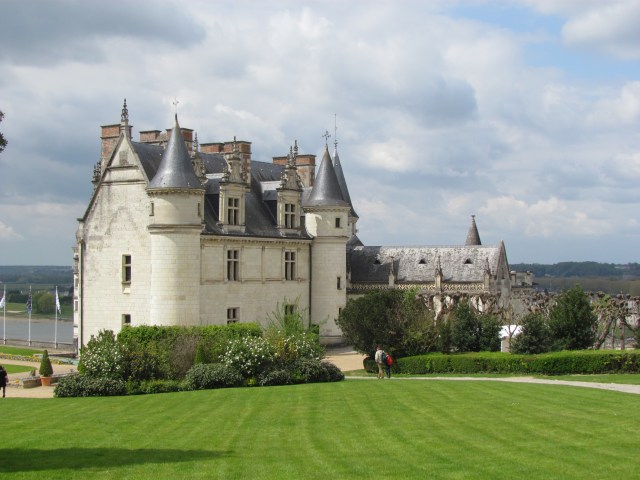
The castle is very photogenic from the outside


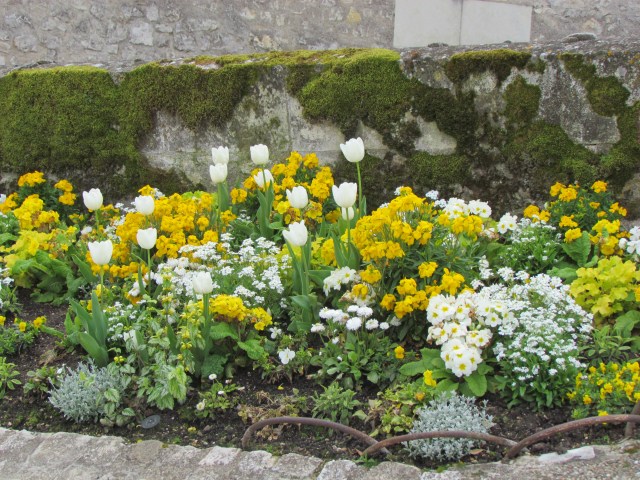
Small spring flower gardens on the castle grounds are very artistically designed.


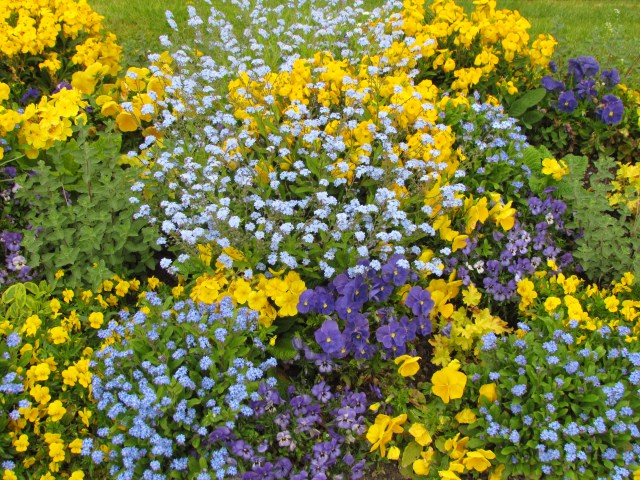
More flowers from the flower gardens on the castle grounds.


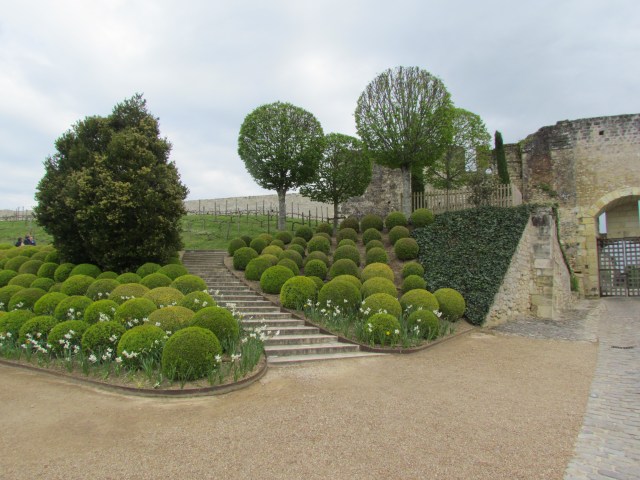
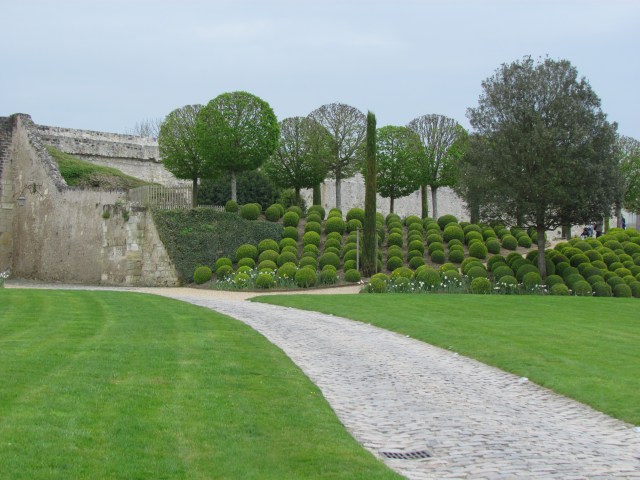
During the past few years, the grounds have been replanted with green oak, boxwoods, Cyprus trees and muscat vines.


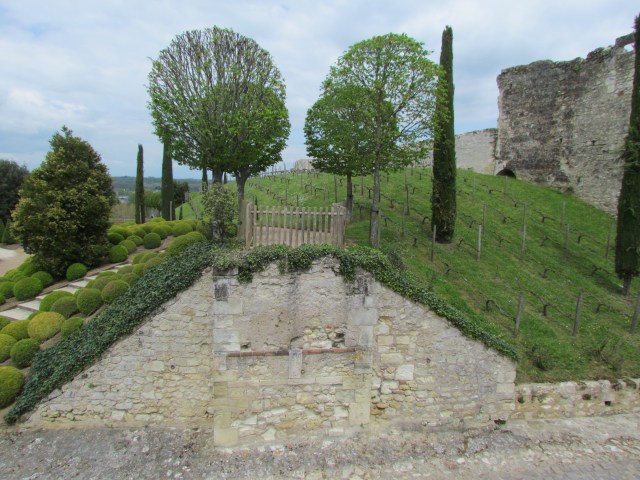
The property contains a significant number of grape vines that were planted in the recent past.
A great deal of pruning clearly takes place on the property, giving the grounds an incredible manicured look.


A great deal of pruning clearly takes place on the property, giving the grounds an incredible manicured look.
Many grapevines have been planted on the grounds in recent years.


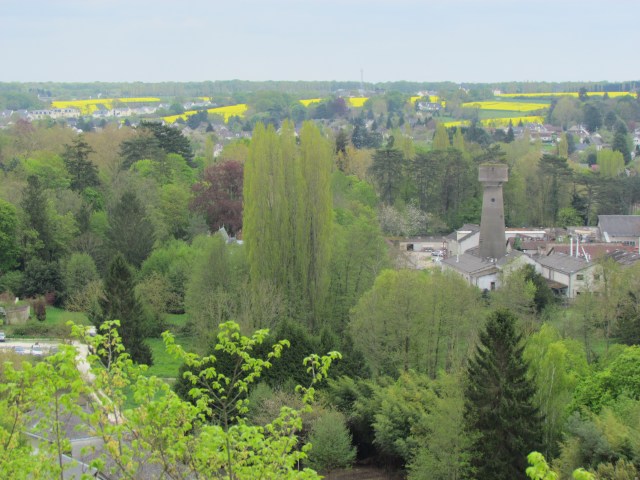
The chateau, which sits high on a bluff, is completely surrounded by a wall. The view from the wall is amazing, including glimpses of the yellow patches that seem to be everywhere.
The chateau, which sits high on a bluff, is completely surrounded by a wall. The view from the wall is amazing, including glimpses of those yellow patches that seem to be everywhere.


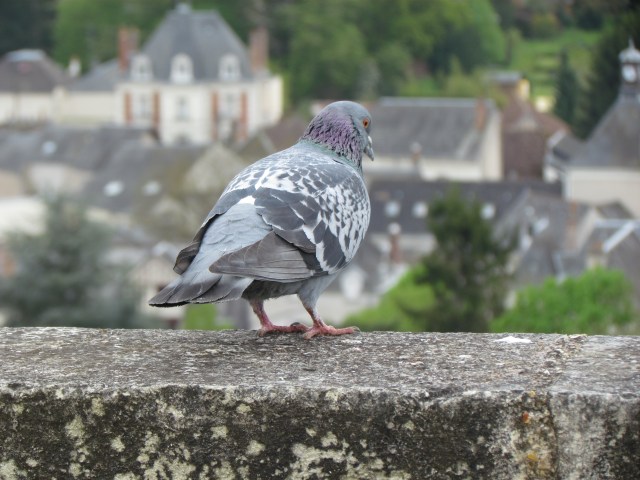
There are lots of pigeons in the area, including the walls. This photo had the extra bonus of including our little B&B in the distance, just to the left of the bird.
There are lots of pigeons in the area, including on the walls. This photo had the extra bonus of including our little B&B in the distance, just to the left of the bird.


Shopping at the Open-Air Market

Amboise is a small town of about 14,000 residents, built on both sides of the widest stretch of the Loire River.  In the middle of the river is an island called Golden Island (Ile d’Or).  The Chateau Royal d’Amboise stands high on a bluff in the center of the city, but more about the Chateau in another post. Amboise also serves as a second home to many celebrities who tend to have grand mansions hidden behind nondescript facades.  Mick Jagger is one of those reported to have a second home here.

Amboise’s big open-air market is held on Sundays in a large parking lot that runs along the river.  It draws huge crowds of locals and tourists alike.  We had a great time there.  Here are just a few of the things we saw.

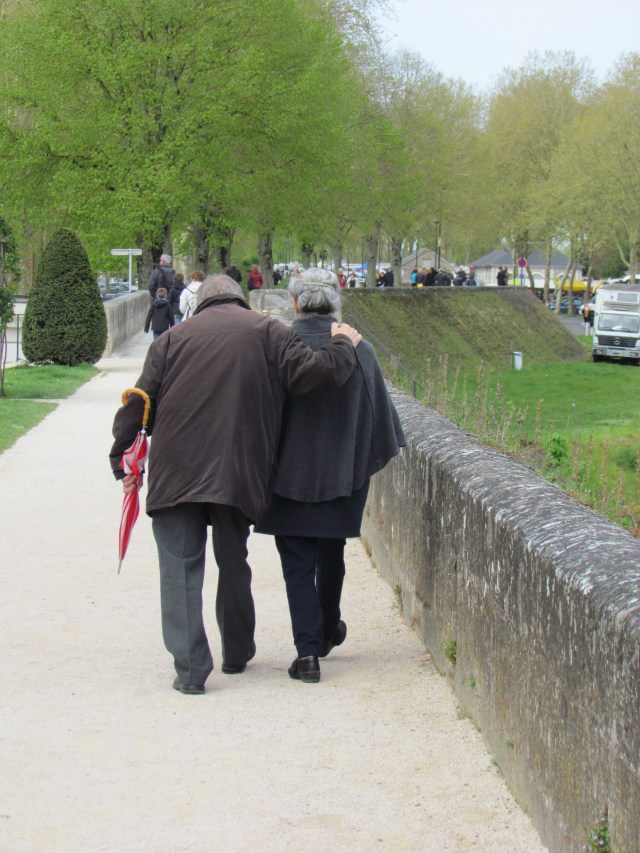
This cute old couple and their umbrella were headed to the market.
This cute little French couple with their umbrella was headed to the market.


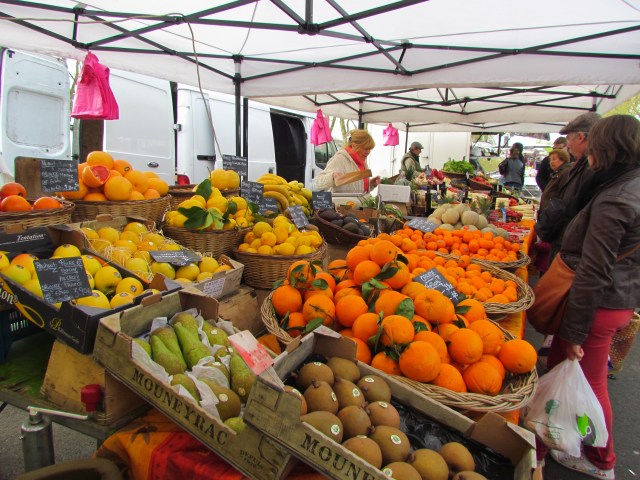
Of course product booths are always popular. These fruits and vegetables were beautiful and weren't just local, although as expected most were.
Of course produce booths are always popular at open-air markets. These fruits and vegetables were beautiful and weren’t just local, although as expected most produce was.


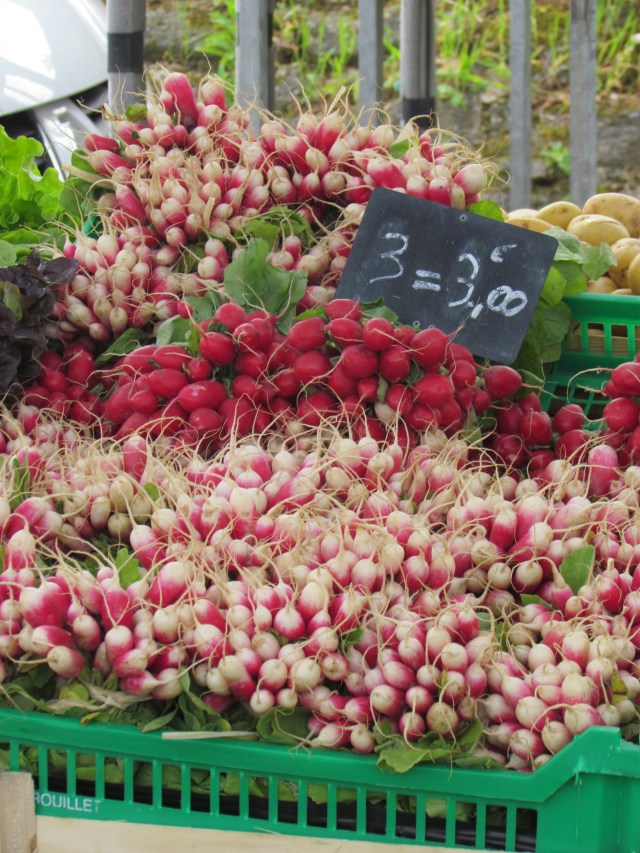
It must be the best time of the year for radishes because these were local and they looked so good.
It must be the best time of the year for radishes because these were local and they looked so tasty.


Separate wine and cheeses booths were very popular. The wine booths would even let you have tastings before you bought.
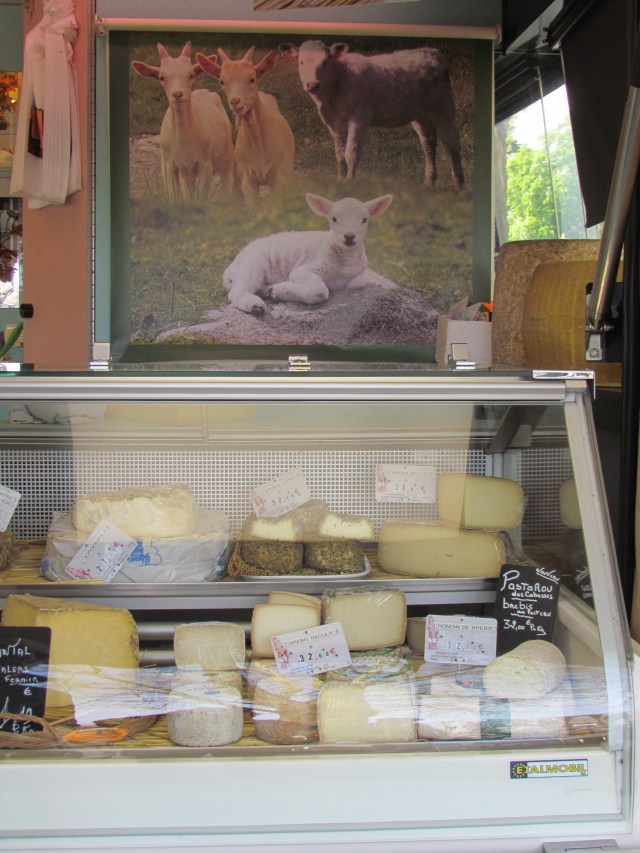
This cow, calf and goats kept watch over this cheese booth, one of several we saw. Both wine and cheeses booths were very popular at the market. The wine booths even allowed you to have tastings before you made your purchase.


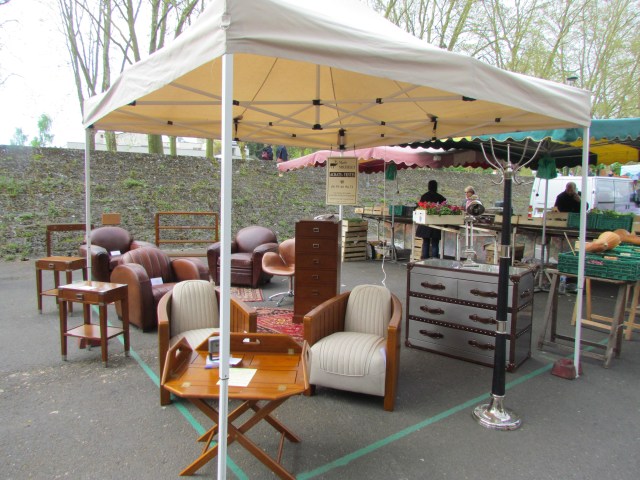
There were even a couple of furniture vendors at the market, as well as a place that sold mattresses.


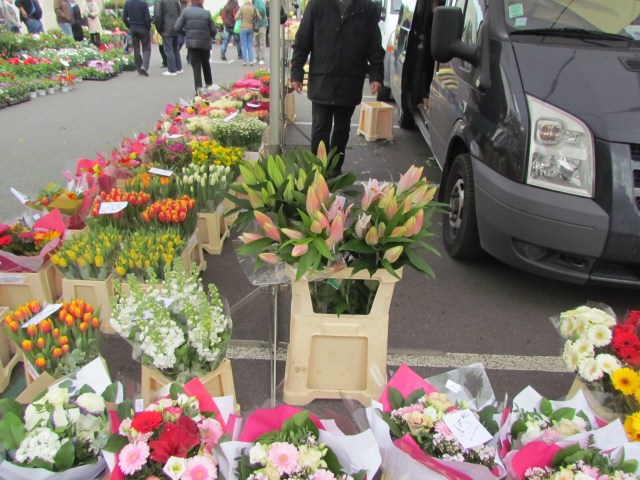
This is the time of year when flowers and plants are popular market purchases. Both the market's cut flower and living plants, shrubs, and trees looked very healthy.
Sprng is the time of year when flowers and plants are popular market purchases. In spite of low temperatures, March-April-May is when Europe sees their huge tulip crop in bloom. Both the market’s cut flowers and living plants, shrubs, and trees looked very vibrant and healthy.


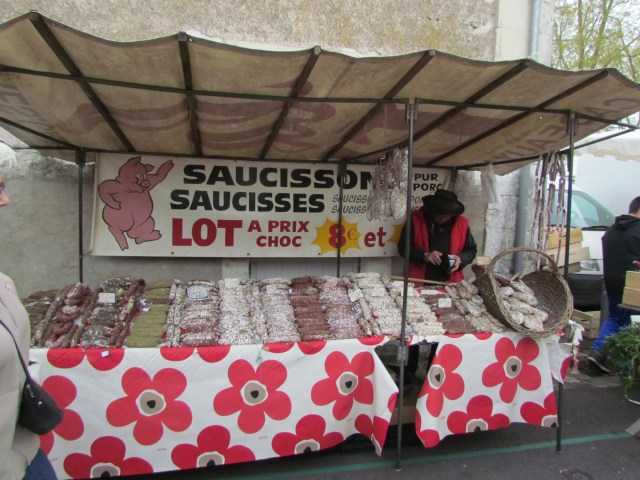
Several sausage booths carried a wide variety of kinds and sizes of sausages.
Several sausage booths presented a wide variety of kinds and sizes of sausages.


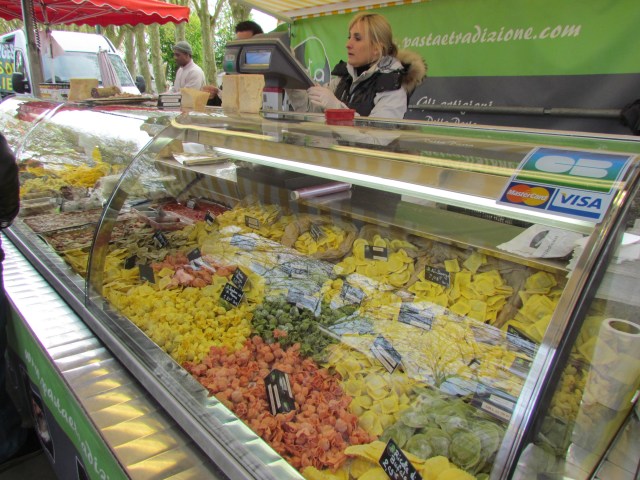
Two of the vendors that surprised us carried only pre-made, filled pastas. They looked so yummy.
Two of the vendors that surprised us carried only filled pasta. They looked so yummy.


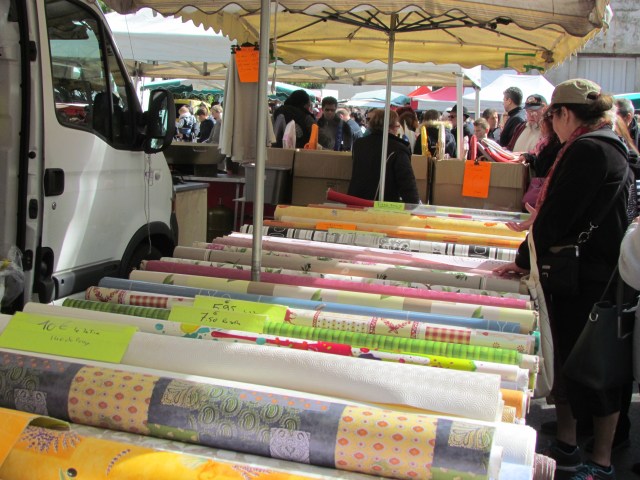
Another surprising vendor was this one with a beautiful and unusual selection of oil clothes.


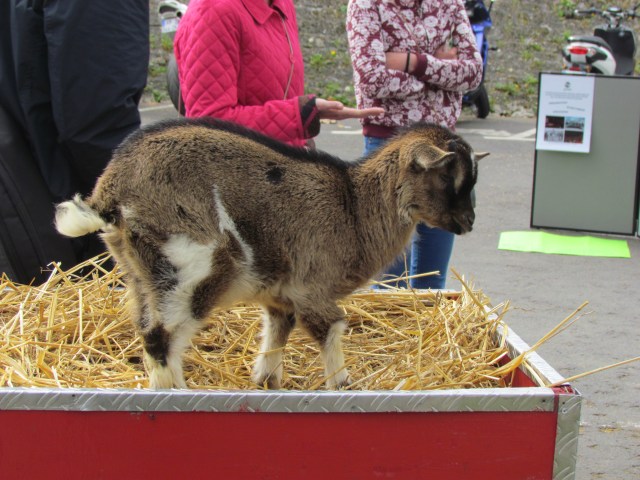
One vendor even brought 2 baby goat. But I think she was actually there to draw attention to the local zoo because she didn't appear to be selling anything.
One vendor even brought 2 baby goats. Actually I think she was only there to draw attention to the local zoo because she didn’t appear to be selling anything.


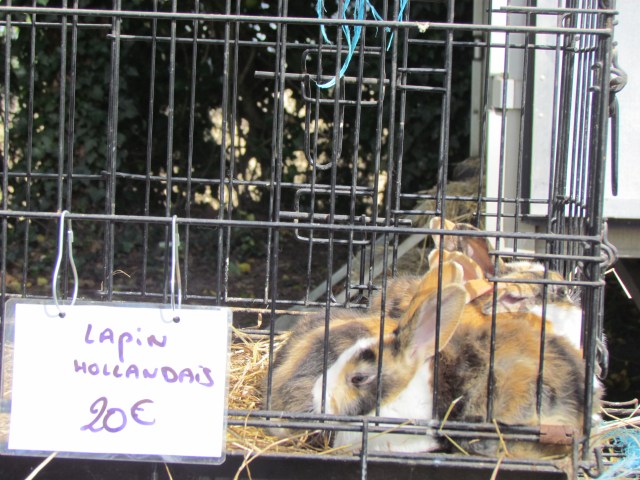
These baby lapis (rabbits) were adorable!
These baby Lapis Hollandais (Dutch rabbits) were adorable! At 20 Euros, they cost about $22.50 each.


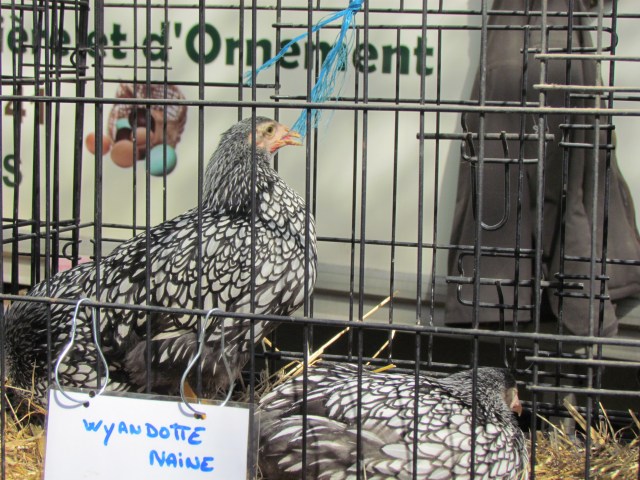
But our favorites of them all were the chickens. These Wyandotte Naines with their white feathers outlined in black look very exotic.
But our favorites were the chickens. These Wyandotte Naines with their white feathers outlined in black looked like they had been designed by an artist.


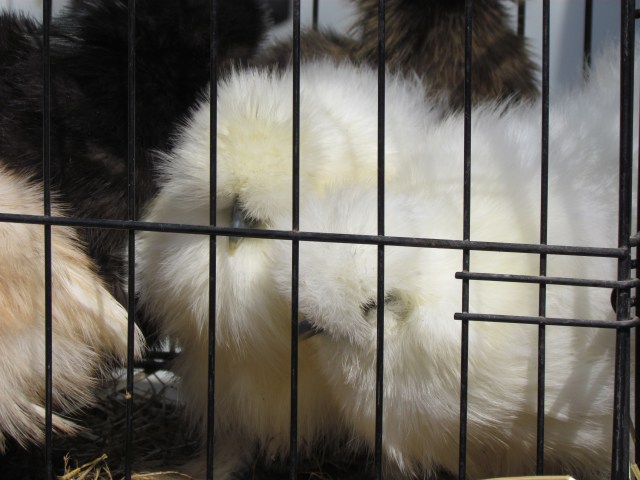
I didn't manage to include the names of these chickens but they were gorgeous with their mohair-soft feathers. Just made us want to pet them.
I didn’t manage to include the names of these chickens but they were gorgeous with their mohair-soft feathers. Just made you want to snuggle with them.

Day 1: Amboise

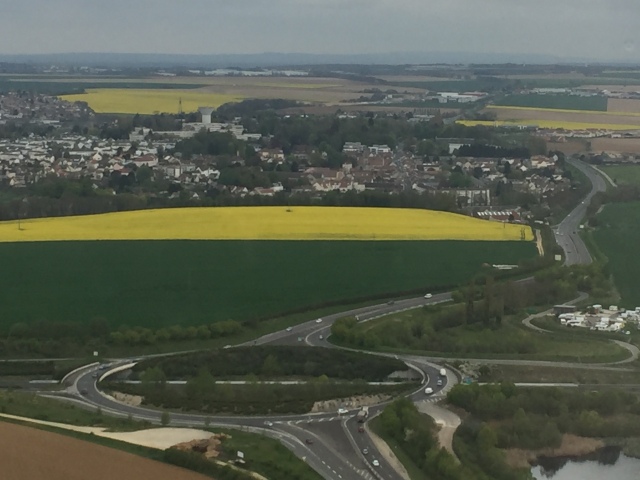
Our plane left LAX at 3:30 p.m. on Friday and we arrived at our hotel in Amboise, our first destination, at 7:30 p.m. on Saturday.  Admittedly  that includes an 8-hour time change, but nevertheless that 28 hours was a VERY long day.  And some of that day went about as smoothly as sandpaper.  But that’s a story for another day.  We flew non-stop to Paris and after a 4-hour layover (the train station is right in the airport – how cool is that!), we caught the fast train to Amboise.  With only 2 stops along the way, the 140-mile trip took just over an hour and most of the time we felt like we were flying.  But the farmland we flew by was gorgeous!  I felt like Sting could step out at any minute with a sweeping rendition of Fields of Gold!  We first noticed those beautiful yellow fields when we were about to land in Paris.

From the plane, these golden fields could be seen in every direction. In the foreground is one of their beloved roundabouts.
From the plane, these golden fields could be seen in every direction. In the foreground is one of their famous roundabouts.

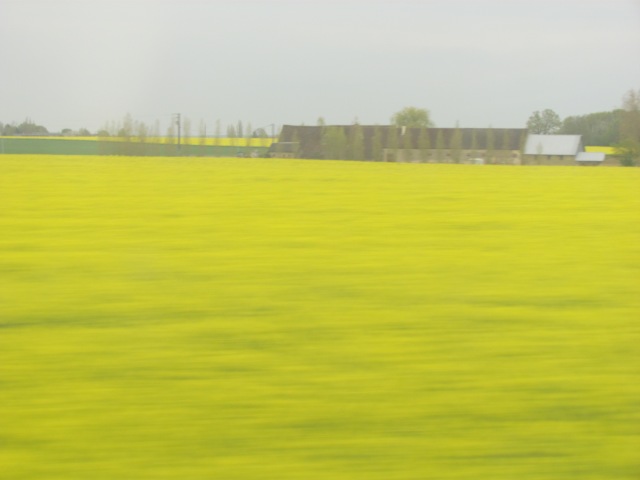
From the train, those fields of gold flew by at about 150 miles per hour! The guy at the rental car place told us the fields are not mustard as we thought, but they use it to make cooking oil and for feeding cattle.  I’ll have to check into that a little more.

A sea of gold from the "Fast Train."
An unreal, rolling sea of gold from the “Fast Train.”


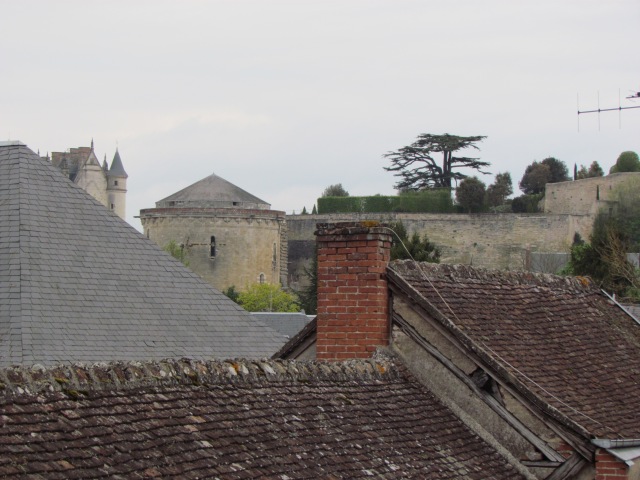
When we finally got to Amboise, first we picked up our red Fiat 500 rental car – it’s the cutest little thing, and I do mean little!. Then we checked into our hotel, which is actually a B&B and has only 4 rooms.  Our room is really charming and has all of its original character from the 18th Century. From our 2nd floor window we get a peak of the edge of the Chateau de Amboise, one of the chateaux on our list.

The view from our window including the corner of the Chateau de Amboise.
The view from our window including a corner of the Chateau de Amboise which can be seen in the upper left.

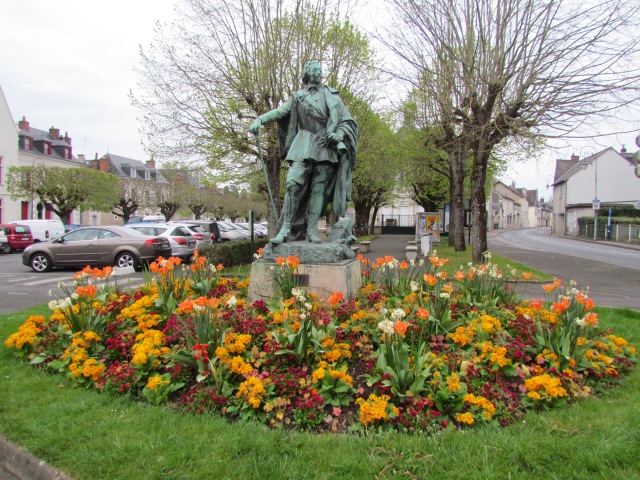
After we checked in, we went out to scout out the main part of the village and find something to eat. We quickly ran across this statue right in the middle of our first little garden on our garden tour trip.

Not sure who he is just yet but we love the flowers.
Our first garden!

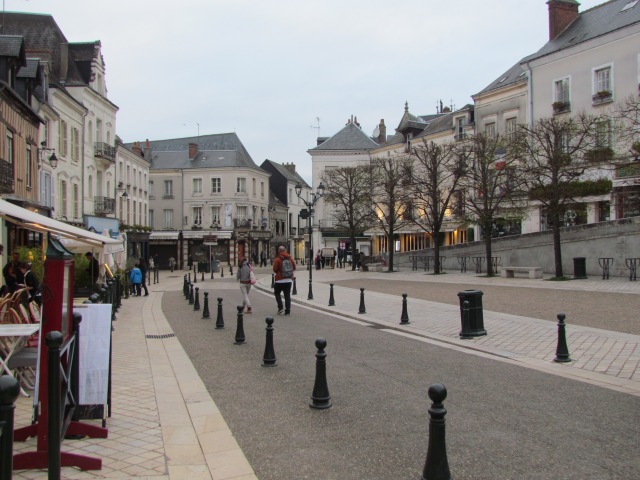
We’re only about 4 blocks from the downtown area – the whole village area is so walkable.

Isn't this area just so inviting? It really caters to tourists and there are lots of good restaurants for a town this size.
Isn’t this area just so inviting? It really caters to tourists and there are lots of good restaurants for a town this size.

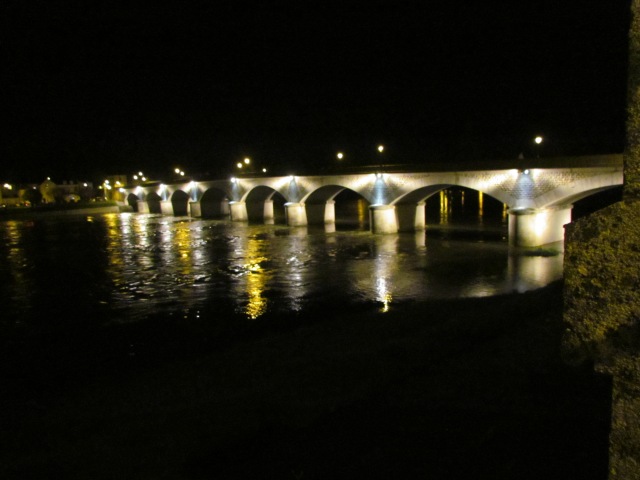
After dinner, we walked over to see if the Chateau is lighted and unfortunately it’s not. But there were lights on the bridge over the Loire River which runs through town right next to the Chateau.

The bridge over the Loire Rivert.
The bridge over the Loire River.

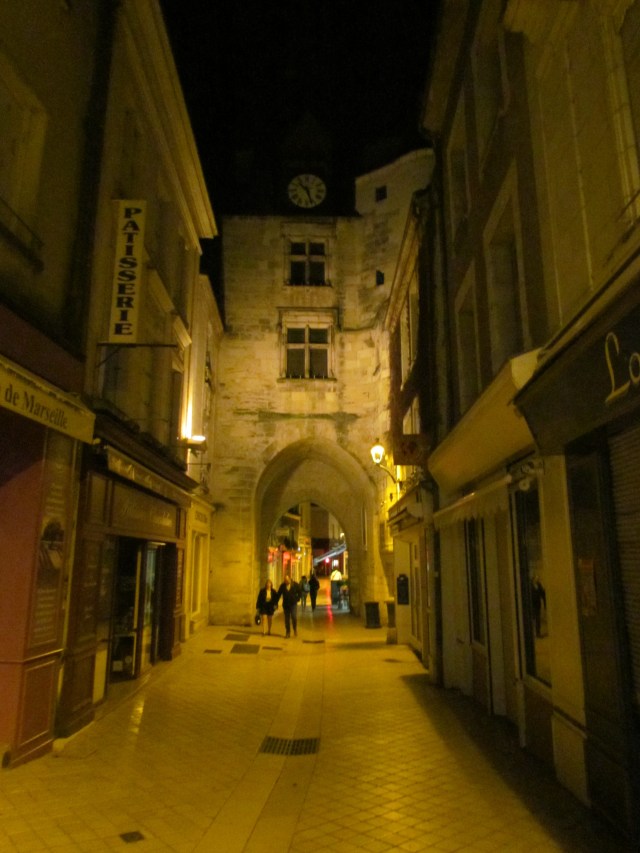
On the way back to our hotel, we ran across this little pedestrian street. I just love these old streets with the glow of their old-fashioned street lights.

One of the many downtown Anboise streets and alleys.

Tomorrow is the weekly street market in Amboise, the biggest and one of the oldest in the area. So we’ll Check that out after breakfast. Then we want to spend at least part of the day in the Chateau de Amboise. And then we’ll see what else comes up. Of course they’ve promised a little rain for us tomorrow – afterall it IS spring.  Oh yes, and Chuck wants to spend a bit more time tomorrow brushing up on his stick shift skills!

Taking Time to Smell the Flowers

Where better to visit in the springtime than France!  We’ve planned a jam-packed, perhaps overly-chateauxed, itinerary. Chuck has done an admirable job of charting our entire trip, making reservations at quaint hotels along the way, and finding a rental car for us – a manual shift, but at least they drive onEiffel Tower 2 the right side of the road! Our journey will begin in Paris where we’ll take the train down to Amboise in the Loire Valley region to pick up our rental car.  We’re going to visit several Chateaux and gardens in the Loire Valley, then drive over to the coast to  spend a few nights at Mont Saint Michel and visit Chateau Ravalet (yes, there’s a connection).  Then we’ll return to Amboise to turn in our rental car and take the train back into Paris where we’ll spend the last 6 nights. And somewhere along the way we’ll stop and visit Giverny – the location of Monet’s famous home and gardens.

We’re delighted you’re coming along.  We can’t wait to get started!

P.S. Check out the column on the right for a mini slideshow of the chateaux on our itinerary. And don’t forget to click the arrow on “Blog Music”  for some French background music to help set the mood.